The windows are running with water every morning
Condensation on windows in a Spanish flat: how to read it
What visible water on the glass can tell you, why it often appears there first, and what to inspect elsewhere in the dwelling.
This is an independent guide to how the air in a home in Catalonia is meant to be renewed: where it should enter, where it should leave, why condensation and damp appear in flats here, and what each system genuinely does. Nothing is sold, installed or quoted for. The coastal climate, the Spanish rules and the way flats here are laid out all change the answer, so advice brought from a colder, drier country often misses.
The windows are running with water every morning
What visible water on the glass can tell you, why it often appears there first, and what to inspect elsewhere in the dwelling.
A dark patch keeps coming back in the same corner
How a cold corner turns into a wet one, and why a patch is not automatically condensation rather than a leak or rain getting in.
The bathroom stays damp for hours after a shower
Admission, transfer and extraction: how to inspect the whole bathroom air path rather than only the fan.
This all started after the new windows went in
What actually disappeared along with the old frames, and how to give the flat back the air supply it had been relying on unnoticed.
The air smells stale even when the flat is not damp
Carbon dioxide, odours, particles and water vapour are different: what ventilation can remove and what needs another response.
We have just moved into an old Barcelona flat
Interior light wells, shared vertical ducts and openings on a single facade: what each layout makes possible and what it rules out.
The coastal flat smells shut up when we arrive
A home closed for weeks in a humid coastal climate: what happens to the air inside, and what is worth doing on arrival and before leaving.
I want to understand the whole thing first
The full route air is supposed to take through a dwelling in Spain, and how to work out which link in that route has stopped working.
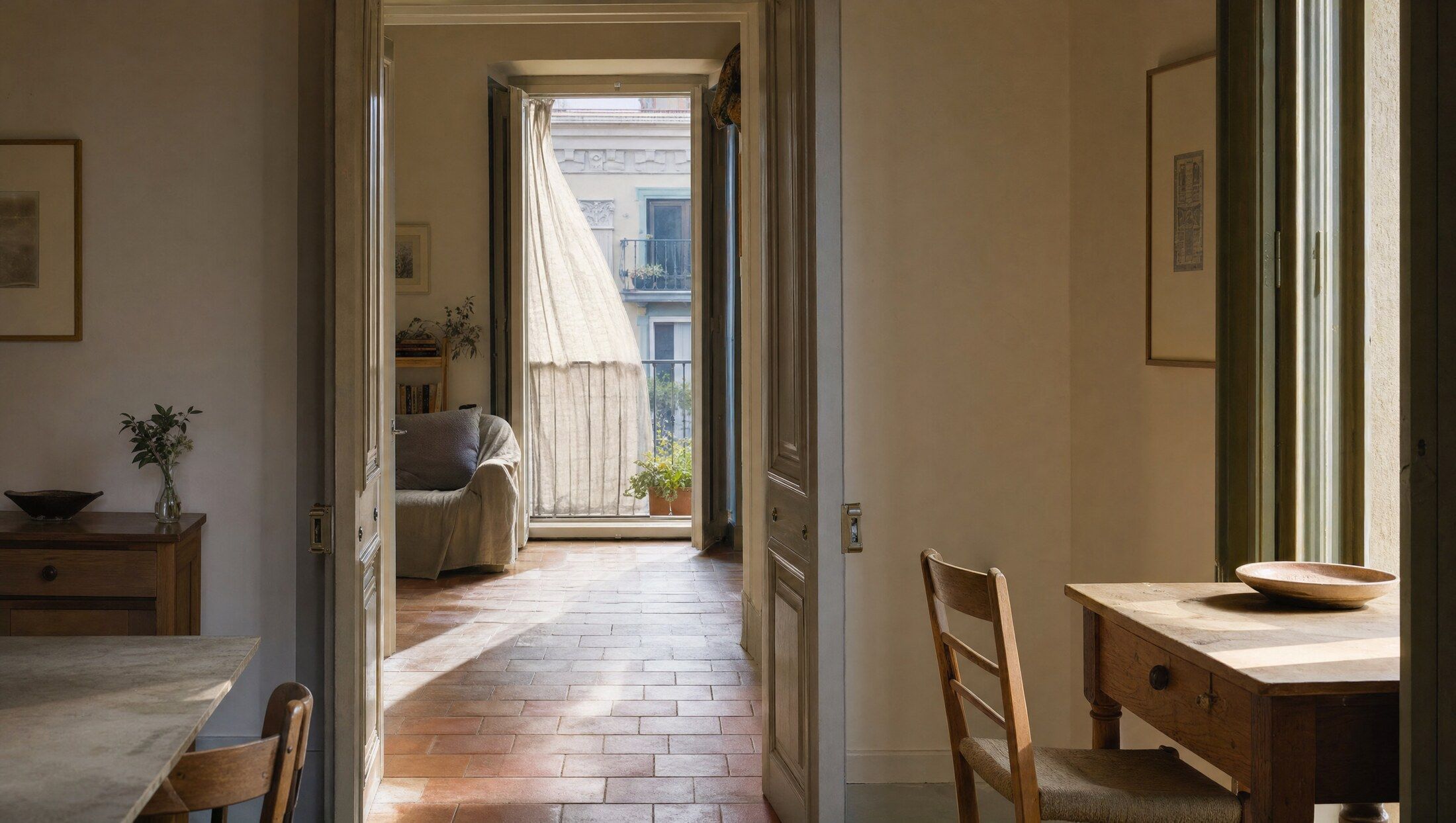
Almost nobody arrives here looking for "ventilation". People arrive because the bedroom glass is wet at seven in the morning, because the bathroom still smells of last night's shower, or because something dark has appeared behind a wardrobe.
So the guides are written in that order: what you are seeing, then the physical mechanism that explains it, then the options. The middle step is the one that gets skipped, and skipping it is how a dehumidifier ends up in a hallway solving a problem that was a missing gap under a door.
The Mediterranean coast gives mild, humid winters and hot, humid summers. Throwing everything open for an hour is a reflex learned where outdoor air is cold and dry; on this coast the air coming in is often carrying plenty of moisture of its own, and the timing that works elsewhere does not transfer unchanged.
The building matters as much as the weather. A bathroom that opens onto an interior light well shared with the flats above and below, a shared vertical duct running up through the block, a flat with every window on one facade, a recent refurbishment that made the place far more airtight than it was designed to be — each of these changes what is physically available to you. Where a page here describes a situation, it is a situation from this housing stock.
An installer's quotation, a meeting of the community of owners or a message from the administrador will not arrive in English. A few terms carry most of the weight: VMC, controlled mechanical ventilation, split into simple flujo and doble flujo; recuperador de calor, the heat exchanger in a balanced system; caudal, the airflow rate a room or a system is meant to move; shunt, a shared vertical duct; pati de llum or patio de luces, an interior light well. The pages give both the English and the local term, because the paperwork will only use one of them.
ventilacion.cat is informational. It does not install, sell, quote, inspect or diagnose at a distance.
Some questions genuinely cannot be answered from a screen. Telling condensation apart from a leak, from damp rising through a wall or from rain penetration takes someone standing in the room; sizing and designing a system for one specific dwelling is work for a competent technician. Nothing written here will ask you to open a communal duct, touch electrical work, go up a facade or apply biocides.
What you can usefully do before calling anyone is arrive with an account of your own flat: which rooms, which surfaces, which hours of the day, and what was changed most recently. That is worth more than any product recommendation.
Homes and place
A postcode does not change the physics. The useful differences are the plan, exposure, occupancy and the routes that air can actually take through the home.
Barcelona · Badalona · L’Hospitalet de Llobregat
Street façade, interior light well, one-sided flat and shared vertical duct are more useful clues than the district name.
Ventilating an old Barcelona flat: the plan decides, not the districtSant Cugat del Vallès · Sabadell · Terrassa
A house may have opposing façades or space for ducts that a compact city flat lacks; read the plan before choosing a method.
Natural ventilation in a Catalan flat: how far airing gets youMataró · Sitges · Vilanova i la Geltrú
Daily occupation and a second home left closed for months create different routines along the same Mediterranean coast.
Ventilation in a coastal home that stands empty for monthsCastelldefels · Blanes · Lloret de Mar
Marine exposure is a reason to separate condensation from wind-driven rain, not a licence to diagnose either from a place name.
Ventilation in a coastal home that stands empty for monthsPlace names describe housing contexts. They are not service-area claims or local prevalence data.
How natural ventilation, controlled mechanical ventilation, double-flow systems and heat recovery actually work, and what a home can realistically expect from each.
How air really moves through a flat with no fans, what cross ventilation needs, and where opening the windows stops being enough in a Barcelona flat.
VMC means a fan running continuously at a designed flow rate. The extract-only and balanced branches, and what fitting either into an existing flat demands.
Balanced ventilation supplies air as well as extracting it. What doble flujo asks of a Spanish flat: two duct networks, filtered supply and a commissioning day.
How the exchanger moves heat between two air streams that never mix, what the declared percentage really measures, and why comfort beats savings on this coast.
Bathrooms, kitchens and bedrooms create different air problems. These guides explain what happens in each room and what the options are.
A shower releases a lot of moisture into a very small room. How the air path through a Catalan bathroom works, and how to tell if the room is really the problem.
Room volume, duct, real delivered flow, noise and control: the order in which to choose a bathroom extractor fan in Spain, and when no fan will fix it.
In an internal bathroom, extraction is the only air route there is. What settles the result is where the replacement air comes from and how long the fan runs.
What builds up in a closed bedroom overnight, and how to renew the air when noise, security or a cold draught rule out an open window in a Catalan flat.
Condensation on walls and glass, damp after replacing windows: what causes it, when ventilation is the answer, and when the problem is something else.
The water on a cold wall was already inside the flat. How condensation works, what the three levers are, and how it differs from a leak or rising damp.
Water on the inside of the glass, between the panes or on the outside means three different things. How to tell them apart in a Catalan flat, and what reduces it.
New windows went in and condensation followed. The windows did not create the damp: they closed an accidental ventilation path the flat had been relying on.
Relative humidity, CO₂ and indoor air quality explained for the people living in the flat, not for the people selling equipment.
Moisture, CO₂, cooking, street particles and emissions from materials. What replacing the air removes, what a filter catches, and why neither does the other's job.
A hygrometer reading means little without the temperature beside it. How to measure humidity in a flat in Catalonia, and why no single correct figure exists.
A CO₂ meter measures how fast occupied air is being replaced, not how clean it is. How to read the curve in a Catalan flat, and what the number cannot see.
Mediterranean climate, older Barcelona apartments, interior light wells, summer and winter, coastal properties and second homes.
Light well, shared shunt, single-aspect plan, a refurbishment nobody redrew, crowded rooms: five illustrative Barcelona arrangements and what each does to the air.
Closing in October and opening at Easter has its own rules: what to leave set up, what can run unattended, and how to reopen without making the damp worse.
Ventilation, dehumidifiers and air conditioning do different things. These comparisons explain which tool solves which problem.
Both machines promise to deal with damp, by opposite means: one replaces the air, the other wrings water out of it. Which does what, and when each wins.
A domestic split recirculates the air already in the room; only refrigerant crosses to the outdoor unit. What that leaves untouched, and what it does do.
Cross-cutting guides that connect symptoms, mechanisms and options.
Spanish flats are designed around one air path: in through the bedrooms, out through the bathroom and kitchen. Here is how it works and where it breaks.
The renewal routes that still work when noise, security, mosquitoes, pollen, heat or an empty flat rule out opening a window in Catalonia.