Damp and condensation
Condensation on windows in a Spanish flat: how to read it
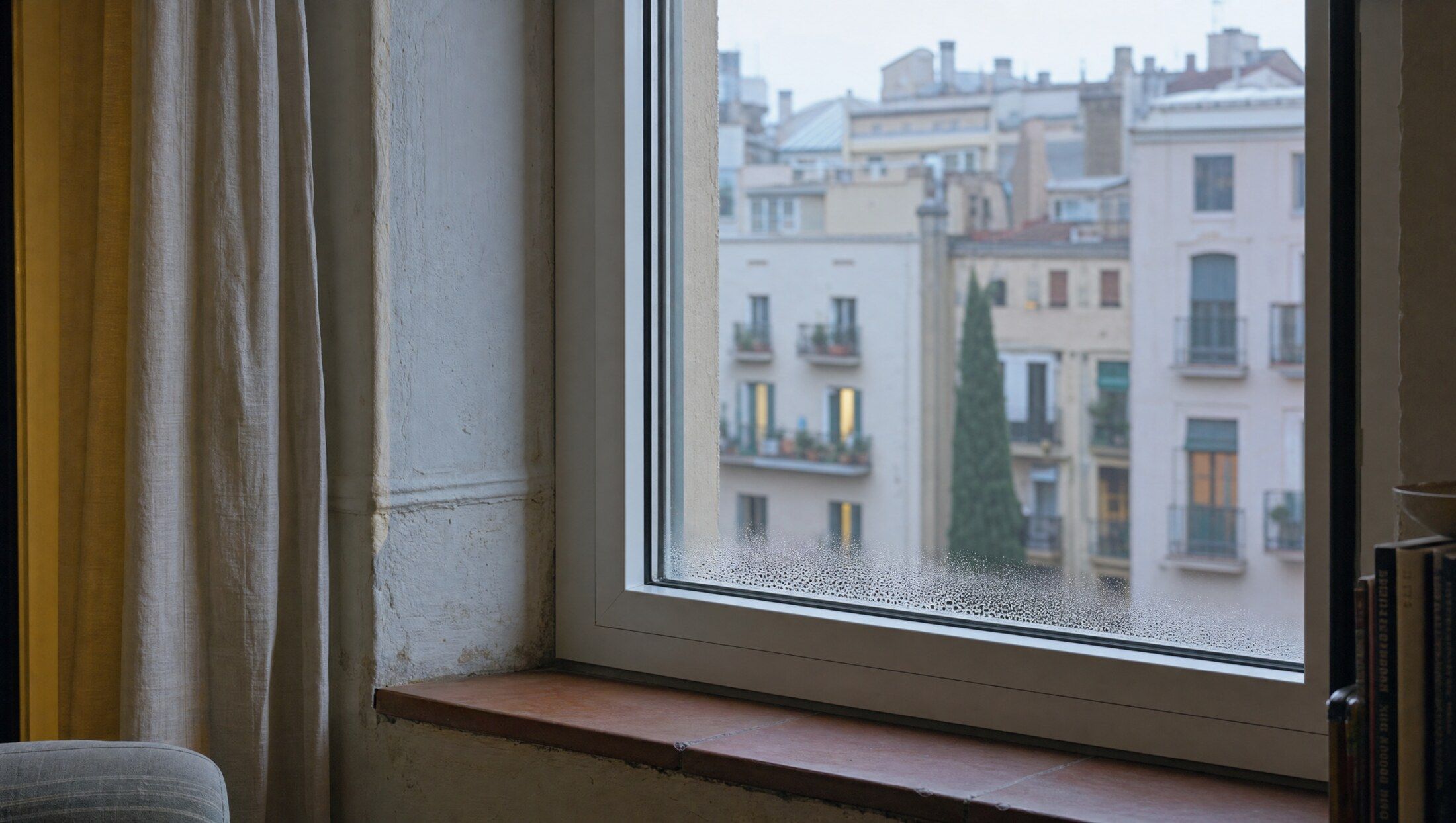
Three different things can put water on a window, and only one of them is about the air in your home. Water on the face you can touch from inside means indoor moisture meeting cold glass. Misting sealed between the two panes means the glazing unit has failed. Water on the outside face means nothing is wrong. Which of the three you have decides whether this is a habit, a repair, or nothing at all.
On this page
- Outdoor air and cold surfaces
- Indoor air, warm and moist
Wipe the pane before you change anything
Run a finger down the glass. If it comes away wet and leaves a clear streak behind, the water is on the inner face and it came out of the air in that room — breathing, the shower, pans on the hob, a drying rack — and the glass was simply the first thing cold enough to collect it. That is the only one of the three cases that has anything to do with ventilation.
If the finger comes away dry and the mist is still there, the water is inside the sealed cavity between the two panes. A double-glazed unit — doble acristalamiento, with the sealed gap known as the cámara — depends on that cavity staying hermetic and on a desiccant inside the spacer bar mopping up the little moisture sealed in with it. When the perimeter seal fails, outdoor air works its way in, the desiccant saturates and the cavity mists from within. You cannot reach it and you cannot wipe it, and it usually leaves a permanent haze or tide marks on the inner surfaces. Airing will never touch it: this is a fault in the window, for a carpintería or a glazier to look at, and it says nothing whatsoever about how the flat is lived in.
The third case is water on the outside face, typically after a still, clear night. The outer pane has radiated its heat away to the open sky, dropped below the dew point of the outdoor air and condensed the humidity that was already out there — which on a humid coast is often plenty. It shows up on glazing that insulates well, precisely because the outer pane is no longer being warmed from inside. It burns off as the sun comes round, and it is neither a defect nor a signal.
Why it is always the glass, and what that makes the window good for
Condensation occurs when air carrying water vapour meets a surface at or below its dew point, and whether that happens is settled by three things together: how much moisture the household puts into the air, how much of that air gets renewed, and how cold the coldest surfaces are. The mechanism in full is a subject of its own. What matters here is why the window always loses first.
A pane of glass is thin, has almost no thermal mass and is in direct contact with outdoors. A wall has mass, finishes and, with luck, insulation, so it lags behind and stays warmer for longer. When the balance in a room tips, the glass crosses the threshold hours before the wall does.
That is worth turning around. The window is not merely where the problem shows up; it is the one free instrument the flat came with. It reports an imbalance while the imbalance is still cheap to correct, before it surfaces somewhere you cannot watch — behind a wardrobe pushed against an external wall, inside a fitted cupboard, in the top corner of a bathroom, on the underside of a mattress. By the time those places are wet, the same imbalance has been running unread for a long time.
One local caveat. Through a mild, humid Mediterranean winter the threshold is crossed intermittently rather than steadily: a fortnight in December when nothing mists at all, then three cold nights when every window in the flat runs. Intermittent is not the same as resolved. Those three nights are the flat's real behaviour under load.
Where the water sits, and what each position is telling you
| Where the water is | What that usually means | Which lever it points at |
|---|---|---|
| A band along the bottom edge and into the corners | The coldest strip of the coldest surface, reached first | Moisture indoors and air renewal |
| The whole pane streaming, most mornings | The moisture load is beating the renewal across the dwelling | Renewal first, moisture second |
| The frame beaded while the glass stays clear | The profile is conducting more heat than the glazing does | Surface temperature, at the frame |
| Dark marks at the reveal rather than water on the glass | The wall around the opening is the cold spot | Surface temperature, at the opening |
Most of that comes down to one idea. A puente térmico — thermal bridge — is a path where heat crosses the envelope faster than through the material either side of it, leaving a cold line on the inside. The perimeter of a glazed unit is one, because the spacer bar joining the two panes conducts; the frame around it is another. That is why misting begins as a band at the bottom and in the corners rather than in the middle of the pane, helped along by the fact that air chilled by the glass becomes denser and slides downwards, so the foot of the window is always working with the coldest air in the room.
The frame deserves separate attention. An aluminium profile with no rotura de puente térmico — no thermal break, meaning no insulating strip separating the outer half of the profile from the inner half — connects outside to inside through metal, and can run with water while the glass beside it stays clear. Fitting better glazing into that same frame relocates the condensation onto the frame rather than removing it. Double glazing does not abolish condensation. It raises the temperature of one surface and frequently hands the problem to the next coldest one.
Once water forms it obeys gravity, so the damage appears below the glass and not on it: the joint between glass and frame, where water stands and stains; the sill, the alféizar, and the interior reveals or jambas, with blistered paint and dark corners; and any timber, MDF or chipboard sitting directly underneath. The drainage slots in the bottom of the frame are worth a look as well, since they exist to let water out of the profile and hold it inside when they are blocked. You can see them from indoors with the window open. Clearing or repairing them is work for a window fitter, not something to go at with a screwdriver from a balcony.
One confusion worth naming rather than repeating: if the misting began in the weeks after new windows were fitted, the windows did not create damp. Much more airtight units withdraw the uncontrolled leakage the flat had been quietly relying on, which leaves the whole load on the planned ventilation route. That is a separate story from this one.
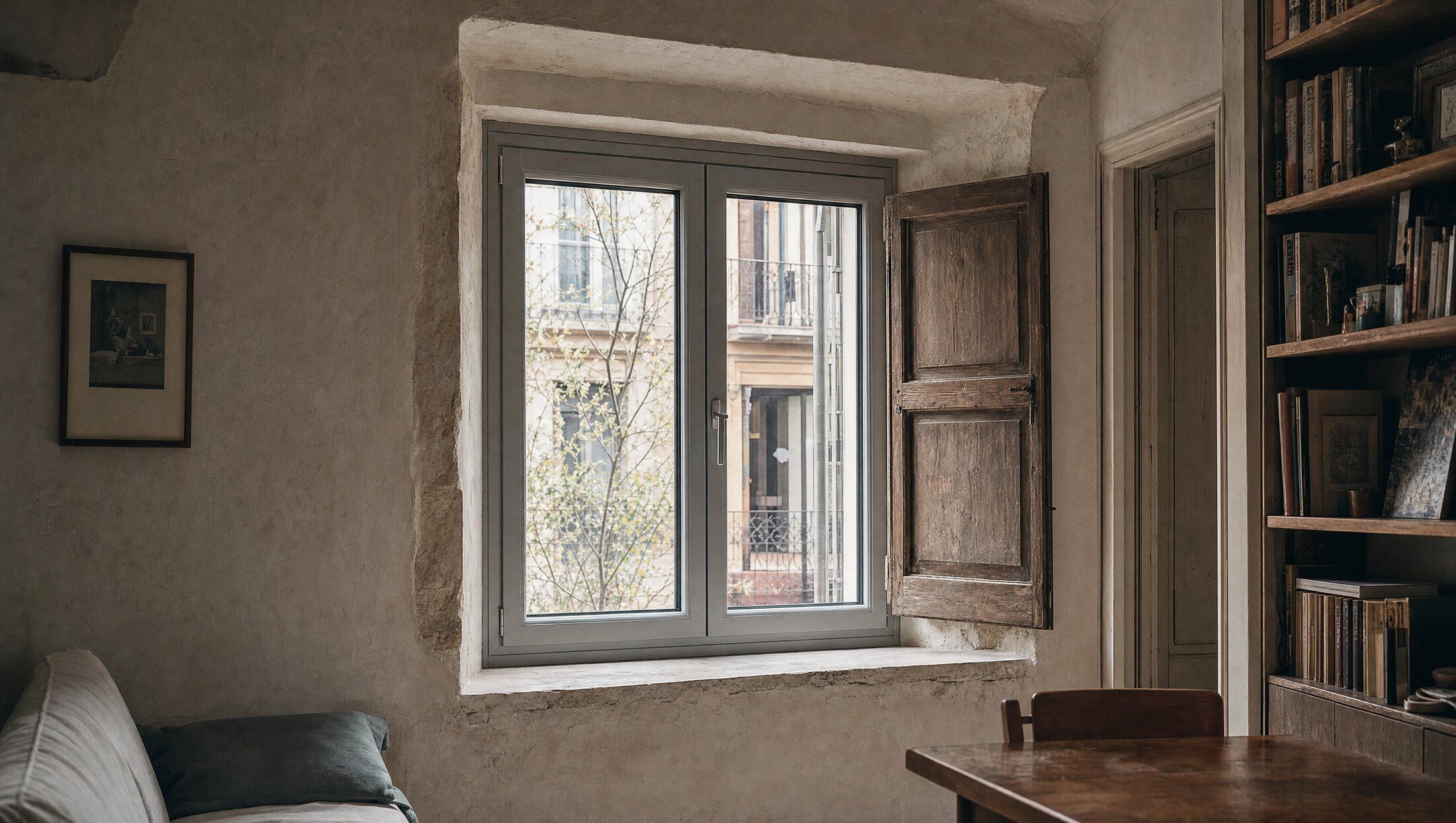
Seven in the morning, bedroom window
Two adults spend seven or eight hours breathing in a room with the door shut and the persiana — the external roller shutter — down. The moisture has nowhere to go, the room cools all night, and two curves peak at once: indoor air at its most humid of the day, outdoor temperature at its overnight minimum, and therefore the glass at its coldest. Nothing begins in the morning. The morning is simply when both peaks coincide and somebody is awake to see it.
Two things sharpen this in a Catalan flat in particular. Where every opening is on the same façade, there is no cross ventilation to be had, and the internal doors have to be open as well before the air has any route at all. And where the bedroom gives onto a patio de luces — pati de llum in Catalan, the interior light well shared by the flats above and below — the air in that shaft is humid and barely stirred, so the same open window renews considerably less than it would onto the street front.
The practical consequence runs against the instinct. Open the room before you make the bed and leave it open while you get on with the morning: bedding and a mattress that took up moisture overnight need the room to keep changing air while they give it back. Shutting the door and leaving for work seals the night's water in.
What actually moves it, in order of effort
Everything that works pulls one of three levers: the moisture put into the air, the air taken out of the dwelling, or the temperature of the cold surfaces. Sorted by what they cost you:
Nothing but attention
- Lids on pans, and leave the campana — the cooker hood — running for a while after you finish rather than only while you cook. DB-HS3, the section of the Spanish technical building code dealing with indoor air quality, requires a specific extraction provision in kitchens for cooking fumes, separate from the general ventilation of the dwelling. Catching steam where it is made is far cheaper than removing it from the whole flat afterwards.
- Run the bathroom extract during the shower and for a stretch after it, instead of switching it on once the mirror has already gone.
- Do not dry laundry in a closed bedroom. A rack gives off water for hours; ten minutes of airing removes the air of that moment, not the vapour still to come all afternoon.
- Air briskly and briefly rather than leaving a window ajar all day. The household ventilation guide put out by the Catalan public broadcaster makes the same point, and a short spell wide open also chills the reveals far less than a narrow gap held open for hours.
A little thought about how air moves
- Leave the air a way through. The model in the technical code admits air in the dry rooms — bedrooms and living rooms — carries it across the dwelling and extracts it from the wet rooms, the bathroom and kitchen, using the undercut of a door or a transfer grille to get between them. An extractor fan can only move air out of a room if replacement air can get in, and a bathroom door fitted tight down to new flooring, with no undercut and no grille, is an easy-to-miss reason a fan can appear to do nothing at all.
- Do not tape over grilles, or over the aireadores in a window frame where the flat has them. Sealing them raises the sense of warmth immediately and makes the condensation worse, because it removes renewal while leaving the moisture production exactly where it was.
- Pull furniture off cold walls, and keep heavy curtains from lying against the glass. A curtain drawn tight to the window traps a layer of still, cold air against the pane, which lowers the glass temperature further and hides the water while it forms.
Money, or works
- Heating more steadily rather than in bursts, and not leaving the bedrooms far colder than the rest of the flat.
- Restoring extraction that genuinely works in the bathroom and the kitchen, judged by whether air actually leaves the room rather than by whether a fan spins.
- Frames, glazing and thermal bridges. This is the surface-temperature lever, and the only one that raises the margin between the glass and the dew point at the window itself.
The things that look like solutions
Wiping, and nothing else. It protects the frame and the sill, which is worth doing on its own account, but the vapour has not gone anywhere. It moves to the next cold surface, which will be less visible and harder to dry out. And wiping without looking first destroys the only evidence you had.
Sealing the room up. Taping vents, blocking grilles, draught-proofing the gap under the door: it feels warmer within ten minutes and is worse within two winters, because it removes renewal and leaves moisture production untouched.
Turning the heating up on its own. Warmer air does lift surface temperatures a little, and it helps. But the glass is thin and remains the cold point, and if moisture keeps building with no way out, the water relocates rather than disappears. Heating the living room hard while the bedrooms stay cold concentrates the whole flat's condensation into the bedrooms.
Running the air conditioning. It is an easy assumption to arrive in Spain with. An ordinary domestic split recirculates the air already in the room; only refrigerant travels between the indoor unit and the box outside, so the appliance does not, by itself, bring in any outdoor air. It will take some water out of the air crossing its cold coil, which is what the condensate drain is for, but that air is the same air, and a closed flat with the AC running can be cool and entirely unrenewed at once. A dehumidifier has the same limit: useful support in one room, no substitute for changing the air.
Anti-damp paint over the marks. Painting a stained reveal touches none of the three levers. It hides the signal until the signal comes back through.
When the window is no longer the right instrument
The glass reads one mechanism well and the others not at all. Signs that something else is going on:
- stains that never dry out, including through a dry spell or across the summer;
- damp low on a wall, rising from the floor rather than falling from the window;
- marks that appear or spread only after rain, or after a wind off the sea;
- damp a long way from any window, or directly beneath a bathroom in the flat above.
Spanish and Catalan keep separate names for these, and the words are worth knowing if you end up describing the problem to a building administrator or a tradesperson. Humedad por condensación is the one this page is about; humedad por filtración is water getting in, from outside or from a failed pipe; humedad por capilaridad is rising damp drawn up through the structure. They are different mechanisms with different remedies, and they cannot be told apart reliably without an inspection on site. Pressing on with ventilation while the actual cause is a leak only extends the damage.
Where persistent damp has already produced visible mould, it is worth treating as more than a cosmetic matter: the World Health Organization's guidance on dampness and mould supports linking persistent indoor dampness and mould with respiratory symptoms. Removing mould that is already there and correcting the air are two separate jobs, and correcting the air does not guarantee it will not return.
Which windows mist, and which do not
The most useful thing about the window as an instrument is that a flat has several of them. The pattern across them says considerably more than any single pane.
- Only the bedroom. A local, overnight problem: occupancy, a shut door, a cold room. Treat the room, not the dwelling.
- Every window, including the well-heated living room. The dwelling as a whole is carrying more moisture than it renews. The lever is renewal, and adjusting habits alone is unlikely to close that gap.
- Only the room giving onto the light well. Look at that room's air route rather than at the flat's overall humidity. The shaft is humid, poorly stirred, and often the room's only opening.
- Bathroom and kitchen clear while the bedrooms mist. Extraction is doing its job where it exists, and the moisture is accumulating where there is none.
- Glass dry, frame and bottom edge still wet. No longer a humidity question but a surface-temperature one, at the frame.
Then change one variable at a time and let the pattern answer. Leave the bedroom door ajar for three nights, or move the drying rack, or run the hood ten minutes longer, and watch which windows drop off the list. Anyone who assesses the flat afterwards can do far more with that than with the sentence "there's damp".
Tell us what's happening at home and, if useful, add photos. A message does not replace an on-site professional assessment.
Tell us about your situationSources
The technical and regulatory statements on this page rest on the sources below.
- Documento Básico HS «Salubridad», Código Técnico de la Edificación — Ministerio de Vivienda y Agenda Urbana / Código Técnico de la Edificación
- WHO Guidelines for Indoor Air Quality: Dampness and Mould — World Health Organization
- Com ventilar bé una casa: guia bàsica de criteris i recomanacions — 3Cat (Corporació Catalana de Mitjans Audiovisuals)