Internal bathrooms
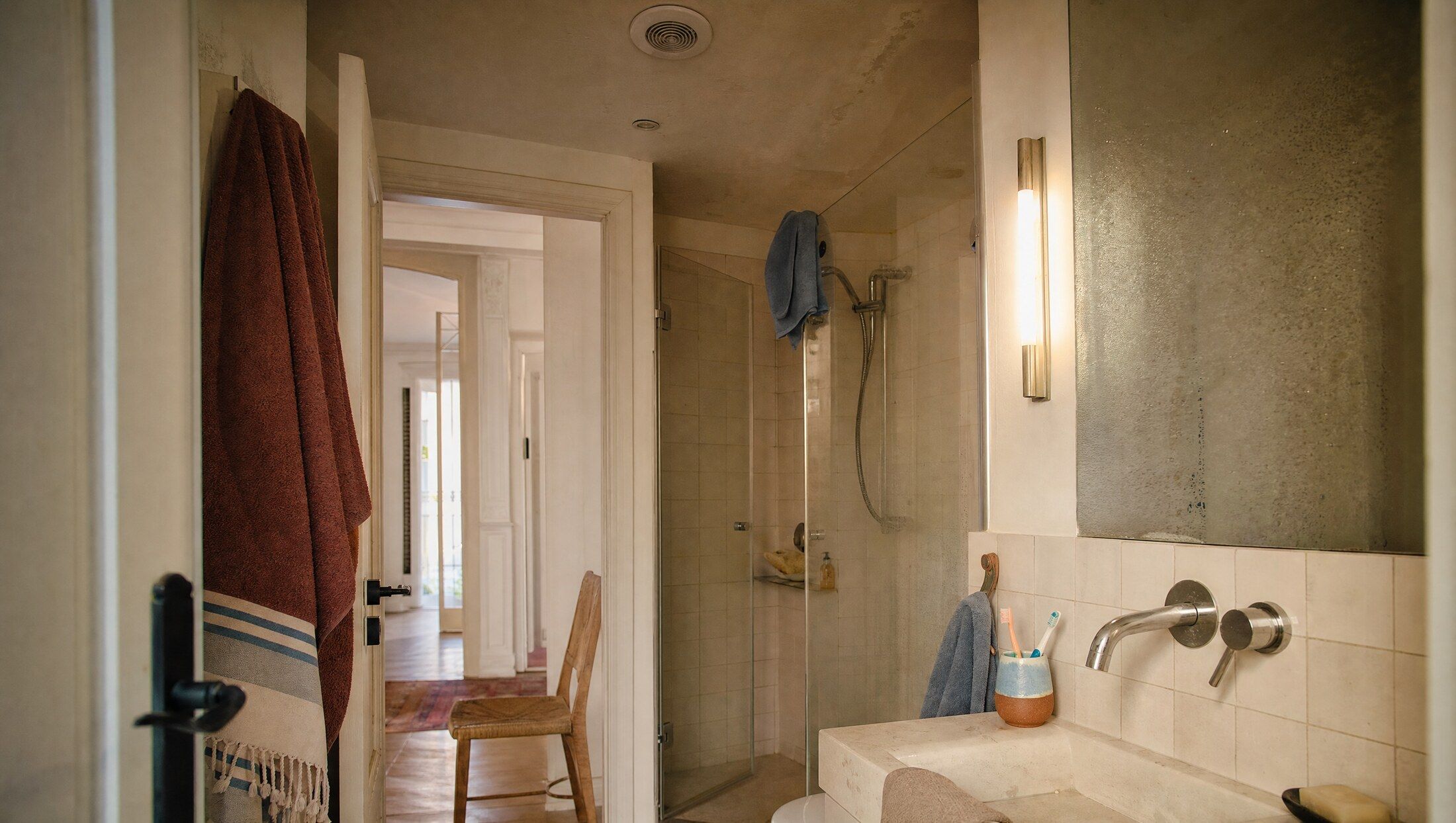
A bathroom with no window: the extractor is the whole system
An internal bathroom has no fallback. If the door is fitted too tight for air to get in, or the fan stops the moment the light goes off, nothing else is renewing the room — and nothing visible warns you, because a room with no external wall rarely has a surface cold enough to stain. What decides it here is where the replacement air comes from and how long extraction runs, not the size of the appliance.
On this page
- Outdoor air and cold surfaces
- Indoor air, warm and moist
- Transfer between rooms
What a listing means by "baño interior"
Spanish and Catalan property vocabulary describes rooms by what they give onto. A baño interior, bany interior, is a bathroom with no opening to the street: sometimes with a small window or grille onto an interior shaft, sometimes with no opening at all. It frees the façade for the rooms people sit in, and it changes what the extractor fan is.
In a bathroom with a window, the fan is the convenient route and the window is the margin. Break the fan and you have an inconvenience. Here the fan is not the main route, it is the only one, and it depends on three conditions that have to hold at the same time.
| The link | What has to be true | How it fails quietly |
|---|---|---|
| The way in | Air can reach the room, under the door or through a transfer grille | A refit raises the floor or fits a tighter door, and nothing looks different |
| The fan | It runs, and keeps running once the room is empty | A run-on timer trimmed to its shortest setting, or wiring to the light alone |
| The way out | The duct genuinely discharges outside the building | Flexible duct crushed, kinked or disconnected above a suspended ceiling |
Three links in series, and the weakest one decides for all three. That is the first reason a bigger appliance so often changes nothing.
The second reason is that failure here makes no noise. When an internal bathroom loses half its extraction, no light comes on. The room simply takes a little longer to dry each year, the smell lingers a little longer, the towels stay a little damper. It is a degradation a household adapts to without ever deciding to.
Every cubic metre out needs a cubic metre in
A fan does not create air. For each cubic metre it pushes down the duct, one cubic metre has to enter the room from somewhere, and in an internal bathroom there is no other opening. The inlet is the doorway. Spanish trades call this aire de reposición: replacement air, make-up air.
This is not a footnote to the code, it is the model the code is built on. The Código Técnico de la Edificación, Documento Básico HS 3, describes a route rather than a device: air admitted in the dry rooms — bedrooms, living room — crossing the circulation space and extracted from the wet rooms, bathroom and kitchen, to outside. The application guide published by the Col·legi d'Arquitectes de Catalunya and the Generalitat's material on controlled mechanical ventilation — ventilació mecànica controlada, VMC — set out the same path, and both treat the transfer openings between rooms as part of the installation rather than as joinery. In a bathroom with a window that route is the design intent. Here it is the entire system.
So the most consequential dimension in the room appears in no catalogue. It is the gap between the door leaf and the finished floor, with the door shut, seen from inside. The things that close it are all small and all easy to wave through during a refurbishment:
- new flooring — tarima, laminate, or a second bed of tiles — laid over the original floor without trimming the door;
- a threshold strip or transition profile landing on the line of the door;
- a replacement door that fits better than the one it replaced, or a rebated leaf that seats on the whole perimeter;
- a draught excluder or brush seal added for smell or noise, which is the exact opposite of what a wet room wants;
- a bath mat sitting against the door, closing the gap precisely when the door is shut;
- a sliding or pocket door, which closes against the jamb and leaves no defined undercut at all.
Where there is a transfer grille — rejilla de paso — what counts is the free area between the louvres, not the size of the frame. A decorative grille with tight blades can look generous and pass a fraction of what it appears to. One painted over during a redecoration loses section with nothing to see.
The route also runs beyond the door. A bathroom in the core of the plan has no external wall, so the air reaching it was born in a room with an opening to the street or the light well and has crossed the hallway to get there. Every closed door on that journey is another restriction. In a much more airtight refurbished flat with openings on a single aspect, that air may not exist anywhere: the fan then takes what it can from the path of least resistance, which in an internal bathroom is often another extract duct in the same dwelling. It re-imports used air instead of renewing anything. It feels like a weak appliance. It is a broken route.
Two assumptions travel with people arriving from elsewhere, and both belong here. Much more airtight windows do not cause damp; they withdraw the uncontrolled infiltration the flat had been silently relying on, leaving the planned route to carry everything. And the split air conditioner in the hall contributes nothing: it recirculates the air already in the room, with only refrigerant moving between the indoor and outdoor units, so no outdoor air arrives through it.
When the only opening gives onto a light well
Some internal bathrooms do have a small opening onto an interior shaft, or discharge into one. It is worth understanding how that space behaves, because it is not open air.
A patio de luces, pati de llum, is a shaft open to the sky that runs the full height of the block, enclosed by the building's own inner façades. The narrowest, serving only wet rooms, are often called patios de ventilación. Little sun reaches the bottom and wind barely enters, so air there moves mainly by temperature difference: it rises when the shaft is warmer than the outside air and stalls on still, mild days. Renewal exists. It is slow.
Three practical consequences follow for a bathroom.
- A window onto a well is not a window onto the street. The exchange is real but far slower, and on the Catalan coast the air arriving is frequently humid already, through mild damp winters and hot humid summers. Ventilating an internal bathroom is not a matter of admitting dry air. It is a matter of putting the loaded air onto a path that ends outside the building.
- The well collects whatever everyone puts into it. Other flats' extraction, cooking, laundry hung on the galleries. A bathroom drawing all its air from the bottom of a shaft can smell of the shaft with nothing broken in your flat at all.
- If the bathroom has a wall on the well, that wall is your cold surface. It is the only element of the room touching the outside, so it is where marks will appear before anywhere else.
What is inside the shaft — the grilles, the ducts discharging into it, the state of the render — is a communal element of the building. It is not somewhere to lean out into, and not something to extend, divert or open up on your own initiative. If you suspect your discharge arrives blocked or badly terminated, the route is the comunidad de propietarios and its administrator, not a ladder.
A room that gives you no signals
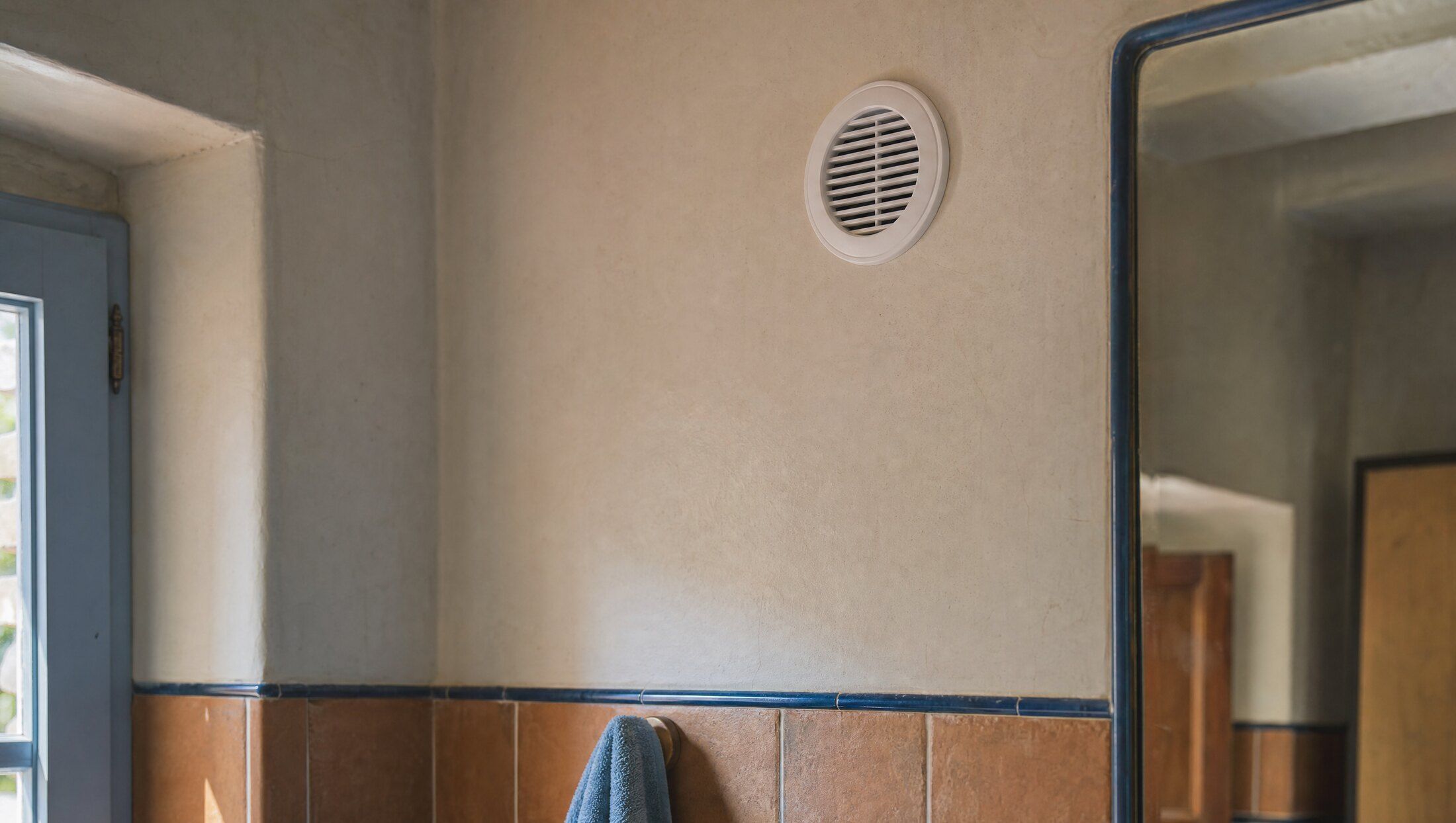
An internal bathroom is surrounded by heated rooms and has no external wall, so it frequently has no surface cold enough for anything to condense on. That sounds like good news and is not. It means the room can stay clean while its ventilation is effectively absent, and that an absence of marks is not evidence of anything working.
The vapour does not disappear. It leaves through the door and condenses on the first cold surface it meets, which is no longer in the bathroom: the back of a wardrobe pushed against an external wall, the ceiling angle in the hallway, the wall of the adjoining bedroom. An immaculate internal bathroom with a stain in the bedroom next door is a coherent pattern, not a coincidence.
Since looking does not help, other things have to be read instead.
- The towel. Hung up after a shower and still damp the following morning, it is a direct measurement of the room's drying capacity, and it costs nothing to take.
- The room's own smell. A bathroom with real extraction does not hold its own smell for hours. If it does, the air is not moving.
- The dirt shadow around the grille. A grille that has been drawing for years marks the surface around it, because dusty air passes through. A spotless grille on an old installation proves nothing by itself — someone may have cleaned it — but it is a hint that little air has been through.
- Two hygrometers. One in the bathroom, one in the hallway. What informs you is not the absolute reading but how long the difference between them takes to close after a shower.
This slowness to show anything is exactly why it is not worth letting run. The World Health Organization's guidelines on dampness and mould support cautious statements linking persistent indoor dampness and mould with respiratory symptoms, and in this room persistent dampness can go a long time without leaving a visible mark that forces anyone to look at it.
Run-on time, or running all the time
In a bathroom with a window, when to extract is a comfort question, because you can always open something. In an internal bathroom the regime is the system, since with the fan off the room renews almost nothing. The dead hours weigh more than the minutes of the shower.
That makes the run-on period — the temporizador on the fan — the most productive variable in the room. When the tap goes off, the bathroom still holds liquid water across every surface: the screen, the tiles, the grout, the towels, the mat. That water takes hours to evaporate, and it evaporates into a sealed box. With a window you deal with the tail whenever it suits you. Without one, the only thing dealing with it is however long the fan keeps turning, which is why a timer set to its minimum turns an adequate appliance into a decorative one. Sometimes the fix needs no new equipment at all, only the adjuster on the fan already installed — and because that means opening an appliance wired into a bathroom circuit, it is a job for a qualified electrician rather than an afternoon's DIY.
Continuous extraction at a low rate does something bursts never do: while it runs, it holds the bathroom slightly below the pressure of the rest of the flat, so air moves into the room rather than out of it, and neither smell nor vapour migrates into the hallway. With burst-only extraction that direction of travel disappears during every hour the fan is off, and the room starts exporting its air to the rest of the home.
The cost should be said plainly. It removes tempered air continuously and it makes noise all day. In a mild Mediterranean winter the thermal penalty is smaller than it would be in a continental climate, but noise is unforgiving: a unit that is tolerable for a ten-minute burst can be unbearable permanently, and one that ends up switched off at the isolator leaves the bathroom exactly where it started. Which appliance tolerates that duty, and at what noise level, is a selection question with its own criteria.
Before deciding the fan is undersized
It is the conclusion that arrives too early, and the expensive one. A handful of things are worth eliminating first, roughly in this order.
- Did it ever work, and what changed? If the room dried acceptably until a refit, a new floor, a new door or works in the flat above, the appliance is not the variable that moved.
- Does it run, and for how long? Leave the room, switch the light off and listen. If it stops immediately, what you have is a regime problem, not a capacity one.
- Can air get in? With the fan running, open the door a hand's width and close it again while you listen. If the note of the fan rises and the rush of air dies as the door closes, the appliance is spinning against a sealed room. You will feel it in the handle too: with the path open, the door takes a little effort to move.
- Is the grille or the duct the restriction? Lint packed between louvres, a decorative grille mounted over the original, a stuck backdraught flap. The room-side face can be cleaned; what sits behind it cannot. After a refit with a suspended ceiling, flexible duct can be crushed or disconnected with nothing visible from below. Looking at the discharge point from outside is reasonable; opening a suspended ceiling, or an access hatch on a shared duct, is not a domestic check.
- Is something competing for the same air? The cooker hood, another wet room's extraction or a vented tumble dryer running at the same moment share out whatever air an airtight flat has.
- Is there any admission air in the flat at all? With every window shut, airtight frames and no trickle vents or purpose-made inlets, no room is being supplied. The internal bathroom is only where it shows first.
One item does not belong on a list you work through yourself. If the flat has a gas water heater or boiler, the interaction between extraction and a combustion appliance is not something to establish by trial and error. That belongs to an authorised installer, and it is a reason to stop at this point rather than experiment.
When all six are clean and the room still will not dry, "the appliance is undersized" finally becomes the next hypothesis — and by then it is a technical decision taken on proper criteria rather than a guess with a receipt attached.
Whose problem is it: yours, the building's, or a professional's
In no other room of a flat does so much of the system sit outside your reach, and knowing where the boundary runs prevents both resignation and the wrong intervention.
Yours, and available today. Keeping the undercut or the transfer grille clear, cleaning the visible face of the grille, not adding draught excluders to a wet room, and leaving the door open when the bathroom is not in use so the room is not a sealed damp box for most of the day.
The building's. The shared vertical duct — the shunt, the stacked flue serving bathrooms one above another — its termination at roof level, the grilles discharging into the light well, and anything another flat's refurbishment has left inside it. It is not something to open, drill, extend or divert on individual initiative, because it affects every flat on the stack. That conversation goes through the community of owners.
A professional's. Any electrical work in a bathroom, an in-line fan mounted above a suspended ceiling, opening an access hatch, anything touching gas appliances, and the sizing itself.
If you rent, the practical boundary is tighter still: trimming a door or changing a timer is not a tenant's unilateral decision, which makes the written record worth more than the opinion. Note what you observed, in what conditions, and what changed when you altered one thing. None of that requires a diagnosis. It requires a description precise enough that whoever reads it next — a landlord, an administrator, an installer — is looking at the same room you are.
Tell us what's happening at home and, if useful, add photos. A message does not replace an on-site professional assessment.
Tell us about your situationSources
The technical and regulatory statements on this page rest on the sources below.
- Documento Básico HS «Salubridad», Código Técnico de la Edificación — Ministerio de Vivienda y Agenda Urbana / Código Técnico de la Edificación
- Guia d’aplicació del DB HS 3 — Qualitat de l’aire interior — Col·legi d’Arquitectes de Catalunya
- Ventilació mecànica controlada en habitatges — Generalitat de Catalunya — Departament d’Habitatge
- WHO Guidelines for Indoor Air Quality: Dampness and Mould — World Health Organization