Bedrooms and sleep
Bedroom ventilation at night: eight hours behind a closed door
A shut bedroom is the hardest room in the flat to keep fresh: little air, a closed door, and the longest unbroken occupancy of the day, all of it while you are asleep. What shifts it is rarely the window thrown wide before bed. It is a small opening that keeps working for eight hours, and a way out of the room through the door, because a bedroom is built to take air in rather than to send it out.
On this page
- Outdoor air and cold surfaces
- Indoor air, warm and moist
What actually changes the air while you sleep
Air in a bedroom only changes if two separate things happen: outdoor air gets in, and the air already in the room gets out. A window handles the first, and only while it is open. The door handles the second, all night, for nothing. Start there.
That makes the order of what pays slightly counter-intuitive:
- the air path — the door, and whether there is a working extract at the far end of it;
- a small opening that stays open, in preference to a large one that does not;
- equipment, once the first two are exhausted or genuinely unavailable.
Opening the window wide for five minutes before getting into bed is the most visible gesture on that list and the shortest-lived. It resets the room and then stops.
The reason this room deserves its own approach is that four conditions coincide here and nowhere else in the flat. The volume of air is a fraction of the dwelling's, smaller still in a compact flat with a small bedroom. The door tends to be closed, by habit or by necessity. The occupancy is the longest continuous stretch of the day — seven or eight hours, often two people, in the same place without a break. And all of it happens while you are asleep, the one part of the day when you cannot notice anything and cannot correct it.
Compare that with the rooms everyone associates with bad air. A kitchen produces a great deal of moisture, but in half-hour bursts, with a hood directly above the source. A bathroom produces more still, concentrated into ten minutes, with an extractor a metre away. The bedroom has neither hood nor extractor. It is the room where occupancy is longest and the removal mechanism is absent.
What builds up in a closed room overnight
Two things, and they come from the same place. Breathing releases carbon dioxide and water vapour; perspiration adds more vapour. Neither has anywhere to go in a closed room, so both climb together, for the same reason, all night.
That simultaneity explains the morning. The shut-in smell when you wake is not something that happened at seven o'clock. It is the end point of eight hours of continuous rise, and the highest concentration of the whole night falls at the moment you open your eyes. Misted bedroom glass has the same origin and the same peak hour, because the accumulated vapour settles on the coldest surface in the room just as the outdoor temperature reaches its pre-dawn minimum.
Carbon dioxide is not, in itself, the thing to fight in a bedroom. It is the most convenient marker of how much air has been renewed, because you produce it steadily and it rises whenever it cannot leave. Monitoring studies in occupied apartments describe exactly this pattern: concentrations that track occupancy room by room, hour by hour. Which figures count as high, and how to read a meter without over-interpreting it, is a different conversation with a page of its own.
A bedroom takes air in; it does not send it out
DB-HS3 — Documento Básico HS 3, Calidad del aire interior, the chapter of the Spanish building code covering indoor air quality — sorts a dwelling into two kinds of room. Dry rooms, estancias secas, meaning bedrooms and living rooms, where air is admitted. Wet rooms, estancias húmedas, meaning bathrooms and kitchens, from which air is extracted. Between them sit transfer openings, and the route always runs the same way: dry room, circulation space, wet room, outside.
Read from the bedroom, that model says something uncomfortable. The room you sleep in was conceived as an entry point and never as an exit. In the vocabulary you will meet on a technical document, the bedroom carries supply air; the extract caudal — the airflow rate — is assigned to another room entirely. Nothing inside the bedroom removes anything.
Close the door and the route is cut. What the room has left is whatever can cross a single opening, and a single opening driven by nothing much: air exchange through one window depends on wind and on a temperature difference, and a muggy coastal night supplies neither. Leaving the door ajar, by contrast, connects the room to a route that actually terminates somewhere.
Provided the terminus exists. If the bathroom and kitchen extract nothing, an open bedroom door connects the room to an equally closed hallway. A sheet of paper against the extract grille can screen for suction at that moment; if it does not stay put, inspect the far end of the route, while remembering that the test does not measure airflow or identify the cause.
The gap under the door is the cheapest component in the whole installation and the easiest one to lose without noticing. A thick rug in the doorway, new flooring laid under an existing door, a draught excluder fitted to stop the hallway cold — any one of them closes the circuit while looking like an improvement.
Noise, security, mosquitoes, cold: why the window stays shut
The reasons people do not sleep with a window open are not fussiness, and advice that ignores them will not be followed for a single night. It is more useful to see what each reason actually rules out, because none of them rules out ventilating.
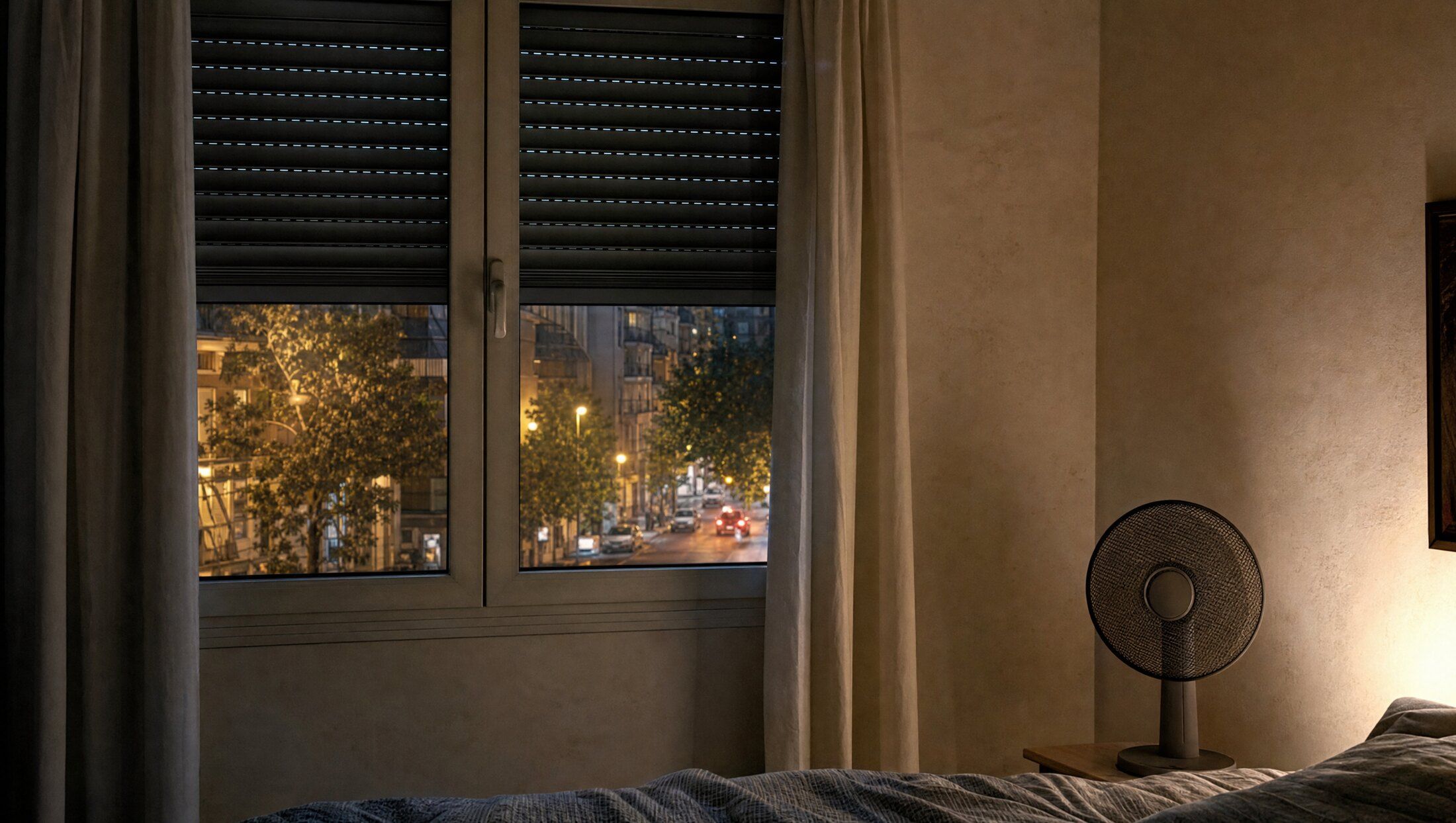
- Noise. The least negotiable of the five. A bedroom over a busy street, a bus stop or a terrace that packs up late does not tolerate an open sash, and even a narrow gap passes far more sound than a closed window does.
- Security. A ground floor, a first floor, or any window reachable from a flat roof, a light well or a communal walkway. Some tilt-and-turn windows — oscilobatientes — have a ventilation position that can be locked in place. That is a small opening, and for the night a small opening does real work.
- Mosquitoes. On the coast in summer, an unscreened opening lasts until the first bite. A mosquitera, the insect screen, is not what stops you ventilating; it is what makes the rest possible, though it does narrow the free area.
- Cold in winter. In a mild Mediterranean winter the objection is almost never the temperature of the incoming air. It is the draught landing on the head of the bed.
- Heat and humidity in summer. On a muggy August night the outdoor air can arrive warm and moisture-laden. Opening still renews, but it may cool very little and will not dry the room when that air carries more water than the indoor air.
One layout complicates all five at once: the bedroom that gives onto an interior light well, the patio de luces or pati de llum, the narrow shaft shared with the flats above and below. Air in a shaft moves far less than air on a street façade, it arrives carrying the humidity and the cooking smells of the shaft itself, and neighbours' noise transmits through it with a clarity the street front never has.
Five options, in order of how much they disturb you
| Option | What it does overnight | What it takes |
|---|---|---|
| Door left ajar rather than shut | Connects the room to the dwelling's air route | Nothing, where noise and privacy allow |
| A permanent transfer path: a clear undercut, or a grille in the door leaf | Keeps the route open with the door closed | A small joinery job |
| A small permanent outdoor opening: a vent in the window frame, or a lockable ventilation position | Admits outdoor air all night with the window shut | Work on the window, plus a look at where the draught lands and what noise comes with it |
| A decentralised unit in the room | Renews that room's air with everything closed | An opening through the façade wall, the building's agreement, and an electrical connection by an installer |
| Whole-dwelling mechanical ventilation | Continuous renewal in every room, not only the bedroom | Design, ducting and building work |
Two things decide how this list behaves in practice. The first: rungs one and two cost nothing, but they only move air if the air has a destination, which sends you back to the extract test above. The second: between rung three and rung four the change is one of kind rather than of budget. Adjusting your own window is work inside your dwelling; making a new opening is work on the façade, which in a block of flats is normally a communal element and not a decision taken from inside one flat.
Two appliances get proposed for this situation and neither performs it. An air purifier filters the air already in the room; it brings none in from outside, so it does nothing about what is accumulating. A domestic split air conditioner recirculates the air that is already in the room as well — only refrigerant travels between the indoor and outdoor units, so the unit does not, by itself, introduce any outdoor air. It may make an August night bearable. It is not renewal, and a ceiling fan is not renewal either.
When the door cannot be left open
Sometimes the closed door is not negotiable: a child woken by the hall light, a cat that must stay out of the room, a flatmate still up, a shared flat where the bedroom door is the front door of your space. The answer then is not to keep pressing for it to be ajar, but to move the function onto a different component — an undercut kept clear, or a transfer grille.
The trade-off there deserves saying plainly. A grille that passes air passes sound, and that is precisely why transfer paths end up blocked with a rolled towel or a piece of furniture. Grilles designed to attenuate crossing noise do attenuate it; they do not cancel it.
The one combination with no cheap way out is door closed, window closed, and no permanent opening anywhere. From there, no change of habit resolves it, and the real choice is between a permanent opening and equipment that renews. It is worth taking that decision knowing that this is what is being decided, rather than treating it as a question of airing for ten more minutes before bed.
A winter night and an August night are different problems
In winter the complaint to design around is the draught, not the cold air itself. An inlet at the far end of the room from the bed head disturbs far less than a window cracked open above the pillows, and over eight hours it renews more. Be wary, too, of leaving the bedroom much colder than the rest of the flat: that concentrates the coldest surfaces in the home exactly where the night's vapour is going to settle.
If the flat has recently had its windows replaced with much more airtight units, the bedroom is where you notice it first. The new frames did not create damp. They removed the uncontrolled infiltration the dwelling had been quietly relying on, and the room that is sealed for eight hours a night is the one with the least margin to absorb that loss.
In summer, and on the coast especially, renewing and cooling are two different aims that one gesture often cannot serve. Night air can arrive warm and humid, so opening keeps renewing but barely cools, and the moisture that comes in is whatever is in the street: ventilating is not drying. In a flat with openings on a single façade there is no night-time cross ventilation to speak of, and the only route available runs through the inside of the dwelling — which means through the internal doors.
What has been measured, and what nobody can promise you
Bedroom air renewal during sleep is an actively researched subject rather than a settled one. There are published reviews of the literature on bedroom ventilation and sleep quality, experimental work that measured how indoor CO₂ behaves through the night when the ventilation of the room is increased, and monitoring studies documenting the concentrations that actually occur in occupied apartments.
What is solidly established is the physical half, and it is the half that is useful to you tonight: less renewal, more accumulation; more renewal, less. That is measured and it repeats.
What cannot be done is the next jump. Those results are reported under specific conditions and do not transfer automatically to one particular room, with its own occupants, its own climate and its own building. Nobody can promise you that leaving the door ajar will make you sleep better, and none of this is medical advice. What you can check for yourself is whether the room smells shut when you wake, which is a direct read-out of how the night went.
Who has to agree, depending on what you change
For an international resident, the practical question is usually not which option is best but which options are yours to take. They separate cleanly.
- Nobody's permission. Clearing the undercut, taking up the rug in the doorway, removing a draught excluder from the bedroom door, moving the bed away from the inlet, keeping the wardrobe off the coldest wall, opening up properly in the morning instead of at bedtime.
- The landlord, if you rent. A grille cut into the door leaf, a vent fitted into the window frame, repairing an extractor that no longer pulls. These are alterations to the property, small as they are, and they belong in a conversation with whoever owns it rather than in a weekend of DIY.
- The building. Anything that passes through the façade or connects into a shared vertical duct, a shunt. Those are generally communal elements, what happens inside them affects every flat on the stack, and they are not something to open or connect into on your own initiative.
- A qualified installer. Electrical connections, and any equipment that has to be fixed through an external wall.
The order of that list is the useful part. Everything in the first group is available tonight and answers to no one, which is a decent argument for exhausting it before anything more involved gets considered — and for arriving at the landlord or the community with a week of specifics rather than a general complaint about a stuffy room.
Tell us what's happening at home and, if useful, add photos. A message does not replace an on-site professional assessment.
Tell us about your situationSources
The technical and regulatory statements on this page rest on the sources below.
- Bedroom ventilation and sleep quality: a review — Science and Technology for the Built Environment
- Bedroom ventilation experiment: effects on sleep and next-day performance — Indoor Air (PubMed 26452168)
- CO₂ monitoring in occupied residential apartments — ScienceDirect (S2950362024000274)
- Documento Básico HS «Salubridad», Código Técnico de la Edificación — Ministerio de Vivienda y Agenda Urbana / Código Técnico de la Edificación