When opening is not an option
Ventilating a flat when you cannot open the windows
Shut a flat with no other opening and it exchanges almost nothing, whatever you run indoors. But ventilating with the windows closed is not a workaround: it is what the Spanish building code describes — a permanent route admitting air in the bedrooms and living room and taking it out of the bathroom and kitchen. The real question is whether your flat has that route, or has lost it.
On this page
- Outdoor air and cold surfaces
- Indoor air, warm and moist
What a closed flat actually exchanges
A dwelling swaps air with the outside only through openings. With every window shut, what is left is whatever leaks through the fabric: the gaps around older frames, the box that an external rolling shutter — a persiana — retracts into, a front door that does not seat properly on its threshold. None of that was designed, none of it can be turned up when the flat is full of people, and a flat whose windows have been replaced with much more airtight units has less of it than it had before. The new frames did not create a problem. They removed an accidental path the dwelling had been quietly living off.
Accept one consequence before going any further. Nothing switched on inside a closed flat renews its air. An appliance with no duct to the outside is working with the air already in the room, whatever the packaging says about purifying or renewing it. If the windows are staying shut, outdoor air arrives through a deliberate opening or it does not arrive.
That is the discouraging half. The encouraging half is that a deliberate opening is not an exotic request.
The building code assumes the windows are shut
DB-HS3 — Documento Básico HS 3, Calidad del aire interior, the indoor-air-quality chapter of the Spanish building code — describes ventilation as a fixture of the dwelling rather than as an activity of the occupant. Outdoor air is admitted in the dry rooms, the estancias secas: bedrooms and living rooms. It is extracted from the wet rooms, the estancias húmedas: bathrooms and kitchens. Transfer openings connect the two, and the route always runs the same way — dry room, circulation space, wet room, outside. The kitchen is given a second, specific extraction for cooking fumes, separate from that general ventilation. Catalan technical guidance on residential ventilation and the professional guidance produced for architects describe the same arrangement in the same order.
Read that description again and notice what never appears in it: at no point does anyone open a window. The route is meant to run whether the flat is occupied, empty, sealed against a January night or shut against an August afternoon.
So if you cannot open the windows, you are not asking for a special dispensation. You are asking a question about your own dwelling: does that permanent route exist here, and does it still work? Where a dwelling was built outside the scope of that document, or where the route was blocked at some point after it was built, the window has been doing the job by default. Nothing is behind it when it stops.
Name the constraint, because they do not rule out the same things
"I can't open the windows" covers situations that behave very differently. Two features decide what remains available: how large an opening the constraint forbids, and how long it lasts.
| The constraint | What it rules out | How long it lasts |
|---|---|---|
| Street noise, a bus stop, a late terrace | Any opening you can hear through — a narrow gap passes far more sound than the closed glass | Permanent, and worst at the hours you are home |
| A ground floor, or a window onto a walkway or light well | Leaving anything open unattended | Permanent |
| Mosquitoes | An unscreened opening after dusk | A coastal season |
| Pollen, or a reaction to what is in the air | Unfiltered air at particular times | Seasonal, and hour by hour |
| Traffic, dust, or smoke outside | Opening onto that façade during the episode | Hours, unpredictably |
| August heat and humidity | Nothing outright, but opening renews without cooling or drying | Seasonal, mostly midday to evening |
| Winter draught | The opening above the sofa or the bed head, rather than the window as such | Seasonal, at the coldest hours |
| Nobody in the flat | Every measure that needs a person present to perform it | Weeks, in a second home |
Three of these have workarounds in timing: a traffic peak, a pollen hour and an August afternoon all pass, and a flat that can be opened at six in the morning is not really a closed-window flat. The others do not pass. A ground-floor window that cannot be left open is closed at every hour of every season, and an empty flat cancels all advice that begins with a verb you are supposed to perform.
There is also a distinction hidden in the second column. Some constraints forbid a large opening but tolerate a small one; noise and security are stricter about size than about duration. Others tolerate no unfiltered opening at all, large or small, which is the only case on the list that a passive vent cannot serve.
The openings you may already have, and how they get lost
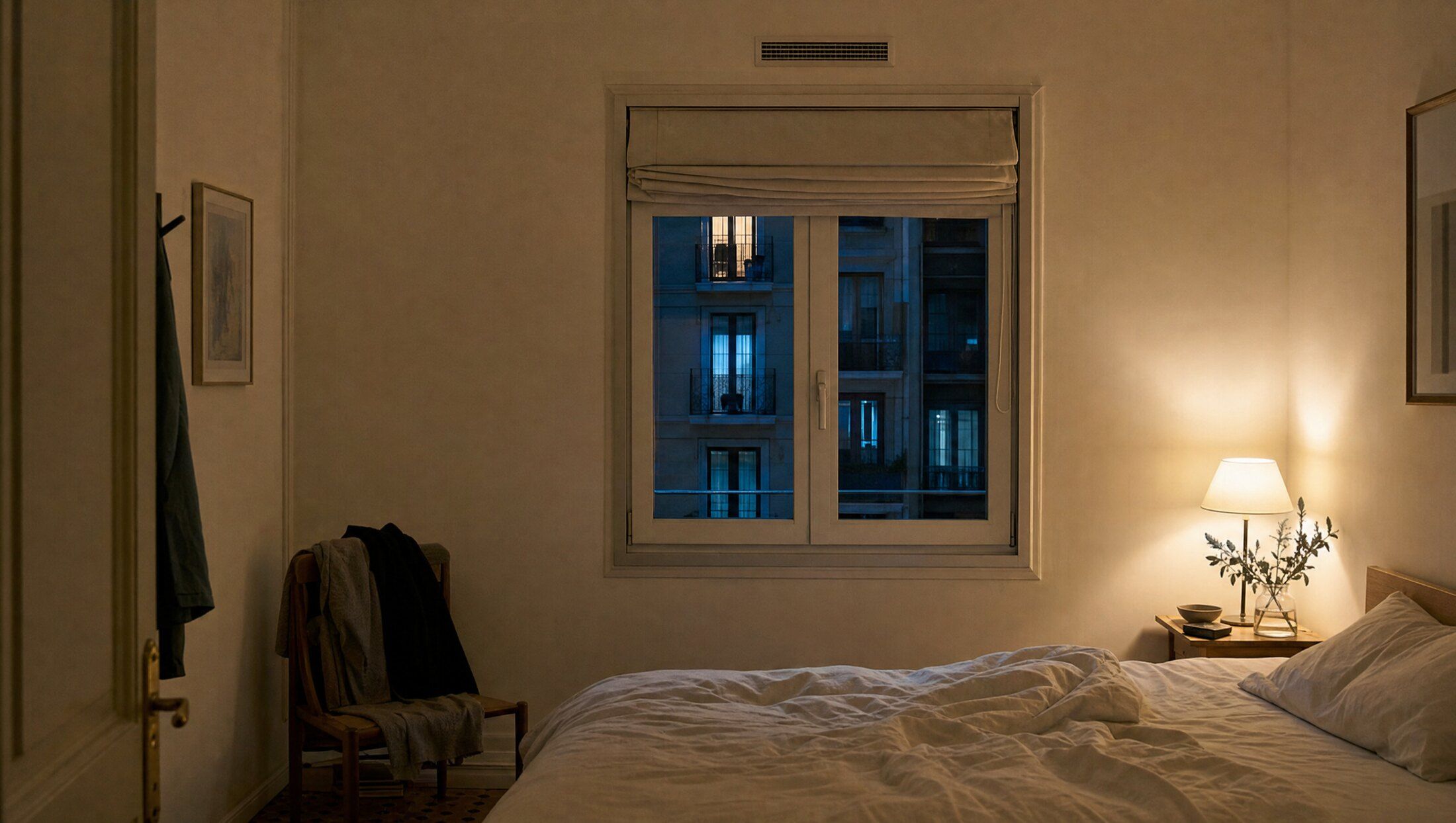
Before anything is bought, it is worth establishing what the flat was given. In a Spanish flat the candidates are:
- vents in the head of the window frame or in the shutter box — aireadores, the equivalent of trickle vents;
- wall grilles, rejillas, usually near the ceiling in a kitchen or bathroom, sometimes connected to a shunt, the shared vertical duct that serves the flats stacked above and below;
- the gap beneath internal doors, or a grille in the door leaf;
- the bathroom and kitchen extract, whether that is a mechanical unit or an opening into the shunt;
- the cooker hood, which handles cooking fumes and only while it is running.
These disappear quietly, and usually for a reason that made sense at the time. A grille gets taped over during a cold spell and stays taped. An aireador gets painted shut. A fitted wardrobe is built across the wall the grille was in. New flooring is laid and the doors, unchanged, now seat on it. A bathroom door is replaced with one that meets the floor cleanly.
Which brings up the point that decides whether any of this works. An extract can only remove air from a room if replacement air can reach that room. A bathroom door with no undercut and no transfer grille is an easy-to-miss reason an extractor can appear to do nothing at all — the fan runs and the mirror stays misted, so the transfer path is one of the first things to check. In a flat kept shut, this matters more than in one that gets aired, because the extract has fewer accidental places to draw from.
One boundary is worth stating plainly. The shunt is shared with other dwellings. Opening it, extending it, or connecting something new to it is not work to carry out from inside your own flat, and what is done to it does not stay inside your own flat either.
The ladder, and where it stops being your decision
| Step | What it changes with everything shut | Whose call it is |
|---|---|---|
| Clear the transfer paths and grilles; confirm the extract pulls | Restores the route the dwelling already had | Yours, this afternoon |
| A permanent controlled inlet: self-regulating, humidity-controlled, or acoustic | Admits outdoor air continuously with no sash open | Yours, but it goes into the window or the wall |
| A decentralised unit serving one room | Renews that room with the flat closed | An opening through the façade, a power supply, and the building's agreement |
| A whole-dwelling mechanical system, a VMC | Continuous renewal in every room at a designed caudal — airflow rate | Technical design, ducting and building work |
The second rung is the one people know least about, and it is where the closed-window case is usually won or lost. Self-regulating inlets hold roughly constant airflow as the pressure across them varies, so the flat does not gulp on a windy day and stall on a still one. Higrorregulable — humidity-controlled — inlets and extracts vary their opening with the humidity in the room, drawing more while a shower or a pan of pasta is loading the air and less when nothing is happening. Humidity-controlled single-flow ventilation is a recognised system subtype in Spain, with a technical suitability document issued by the Instituto Eduardo Torroja. Attenuating vents pass air while damping some of the sound crossing with it; how much they damp depends on the product and on what the opening replaces, and no vent damps as well as the closed window it interrupts.
Between the second rung and the third, the change is one of kind rather than of budget. Fitting a vent into your own window is work inside your dwelling. Making a new hole through the façade is work on a communal element of the building, and the electrical connection is a job for an installer. That step is the point at which other people acquire a say.
One capability only appears at the third rung and above. A route that draws air through a duct can filter what it admits; an opening in a wall admits whatever is on the other side of it. For the noise, security and mosquito constraints, a passive inlet is a real answer. For pollen and for street-level particles, it is a partial one.
Four appliances that renew nothing
- Air conditioning. An ordinary domestic split recirculates the air already in the room; only refrigerant travels between the indoor and outdoor units, so the appliance introduces no outdoor air by itself.
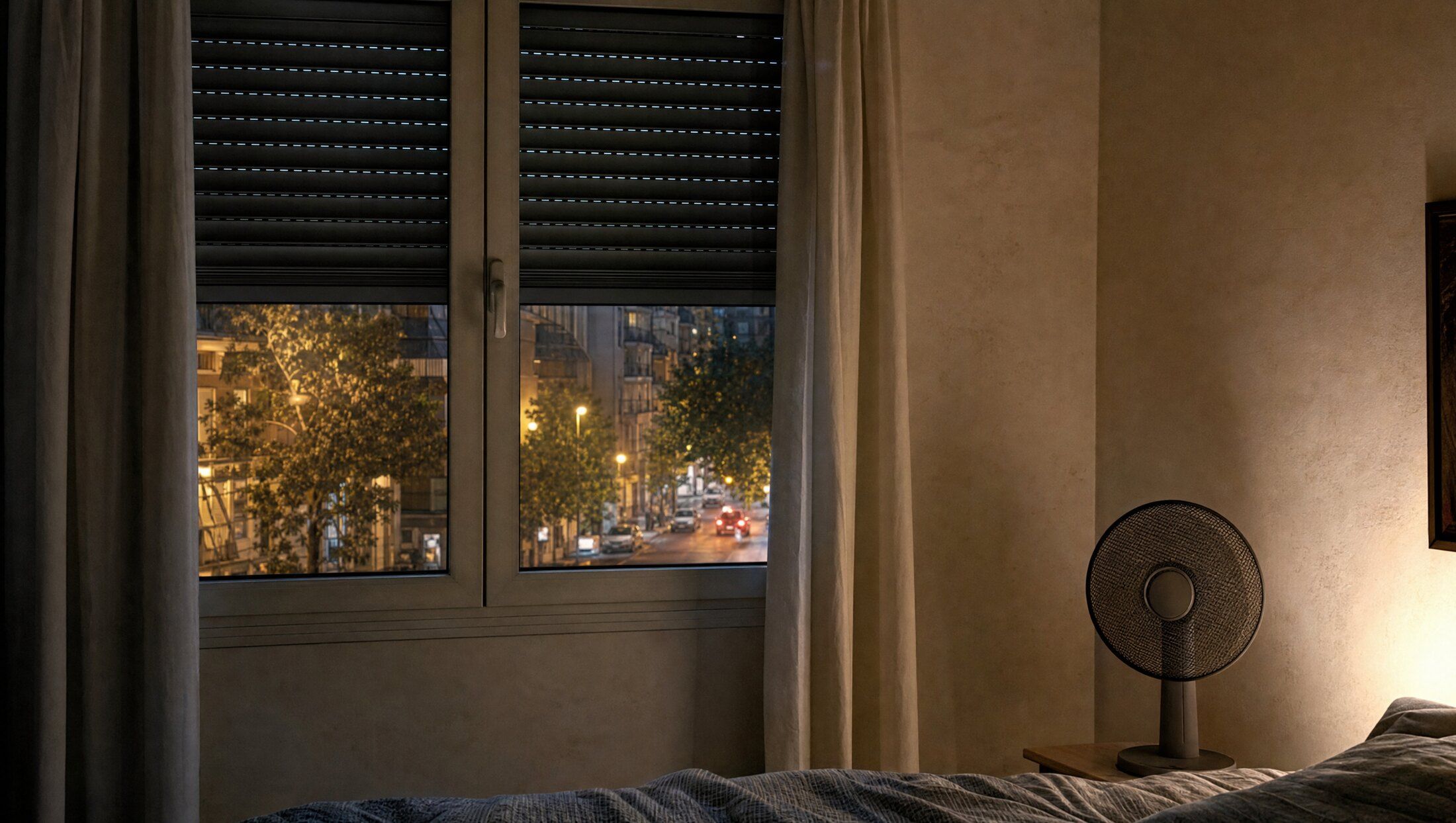
- A fan. It moves the room's air past your skin, which feels cooler; it is the same air, faster.
- An air purifier. It filters particles out of the air already indoors, so nothing enters and nothing leaves, and water vapour and carbon dioxide carry on rising exactly as before.
- A dehumidifier. It takes water vapour out of the room's air, which can be useful in a closed room, but the air is the same air afterwards, only drier.
Each of these does its own job. None of them is a path. Their appeal is easy to see: they are the four things that can be plugged in without asking anyone's permission, in a situation where the real answer requires an opening and, above a certain point, somebody else's agreement.
When keeping the windows shut is the correct decision
There are hours when the right advice is not to open. A smoke plume, a street full of dust after an incident, a window that a small child can reach and work, a pollen peak for somebody who reacts badly to it. In those hours opening is the worse of two options, and telling somebody to air the flat anyway is a slogan rather than advice.
What follows is not that the flat goes without air. It is that renewal should not depend on the moment. A small opening running steadily is not immune to what is outside — it admits the street too — but it does not deliver an hour of it in one gesture, and a ducted route can be filtered before the air arrives. The point of a permanent provision is that it does not require anyone to make a good judgement at four in the afternoon.
The strongest version of that argument is the flat with nobody in it. A coastal apartment closed from October until Easter has no one to open anything, no one to notice a smell on returning until the smell is already established, and no habit that can be improved. Whatever renews the air there works while the door is locked or it does not work.
Where the same constraint lands differently
A single-aspect flat has no cross ventilation to lose, so shutting it changes less than it would elsewhere. What it leaves you with is the internal route only, which puts the doors and the far-end extract ahead of anything done at a window.
A room onto an interior light well — a pati de llum, patio de luces — is the case where opening delivers least: the air in a narrow shaft is stiller and damper than street air, so a permanent inlet gives up less than it would on the façade. It is also the case where the opening is not solely yours to alter.
A ground floor is the constraint with no seasonal relief and no workaround in timing. The honest shortlist is a fixed opening that cannot be climbed through, or equipment.
A recently refurbished flat is the odd one out here, because the occupant is not refusing to open anything. Shutting the windows now does something it did not use to do, since the leakage that quietly covered the gap has been engineered out. A planned route in this flat is not an upgrade; it replaces something that was removed.
A flat left locked for a season cancels every step on the ladder that needs a hand on a handle. From the second rung upwards, everything keeps working with nobody there — which is why, for a house closed from October to Easter, the choice between a permanent opening and a system that runs unattended is not a refinement at the end of the decision. It is the decision.
Tell us what's happening at home and, if useful, add photos. A message does not replace an on-site professional assessment.
Tell us about your situationSources
The technical and regulatory statements on this page rest on the sources below.
- Documento Básico HS «Salubridad», Código Técnico de la Edificación — Ministerio de Vivienda y Agenda Urbana / Código Técnico de la Edificación
- Ventilació mecànica controlada en habitatges — Generalitat de Catalunya — Departament d’Habitatge
- Guia d’aplicació del DB HS 3 — Qualitat de l’aire interior — Col·legi d’Arquitectes de Catalunya
- DIT 623R/23 — Ventilación mecánica higrorregulable — Instituto de Ciencias de la Construcción Eduardo Torroja (IETcc-CSIC)