Bathroom
Bathroom ventilation in a Spanish flat: why the room stays wet
A bathroom that is still damp hours after a shower usually has one of three faults: replacement air cannot reach the room, the extraction is working on the wrong half of the problem, or the moisture belongs to the whole flat and the bathroom is simply the smallest room, where it shows first. All three can be told apart in a day, without buying anything.
On this page
- Outdoor air and cold surfaces
- Indoor air, warm and moist
- Transfer between rooms
The room is soaked in minutes and dries over hours
Nothing about a bathroom is continuously humid. What it has is a sharp, repeated event. Hot water is sprayed into a room with very little air in it, for a few minutes, once or twice a day. The same release into a living room would barely register, because a living room has volume to absorb it and its cold surfaces are far from the source. A bathroom has neither. The mirror goes first because it is thin, smooth and has no thermal mass, so it falls below the dew point of the air touching it before anything else in the room does.
The half that gets missed happens after the tap goes off. At that moment most of the water still waiting to leave the room is not in the air at all. It is lying on the shower screen, the tiles, the floor and the towels, and it will evaporate slowly over the next few hours — usually with the door shut and the fan already off.
So the room runs on two clocks. The release is measured in minutes. The removal is measured in hours. Extraction wired to the light switch works on the first clock and abandons the second, which is why a bathroom can be properly ventilated during the shower and still be damp at lunchtime.
Neither clock gets much outside help on this coast. Catalan winters are mild and humid, summers are hot and humid, and the outdoor air you let in is often not the dry sponge the same advice assumes in a continental climate. Opening the window helps. It is not a reliable answer to an evaporation that carries on all morning.
The air an extractor cannot make for itself
A fan moves air out of a room. It cannot create the air that takes its place, so the room gives up only as much as arrives from somewhere else — and where that "somewhere else" is has been decided in advance, not left to chance.
Spain sets the arrangement out in DB-HS3, Calidad del aire interior, the indoor air quality section of the Código Técnico de la Edificación. A dwelling is split into dry rooms, where outdoor air is admitted — bedrooms, living rooms — and wet rooms, from which it is extracted: bathrooms and the kitchen. Between them sit transfer openings, the aberturas de paso of the Spanish documents, obertures de pas in Catalan. The application guidance published by the Catalan architects' association and the Generalitat's material on ventilació mecànica controlada (VMC, controlled mechanical ventilation) describe the same route: in at the dry rooms, across the flat, out through the wet rooms.
Read from the bathroom, that has an awkward consequence. The room is the far end of a chain, so how well the fan performs is settled largely in parts of the flat you are not standing in.
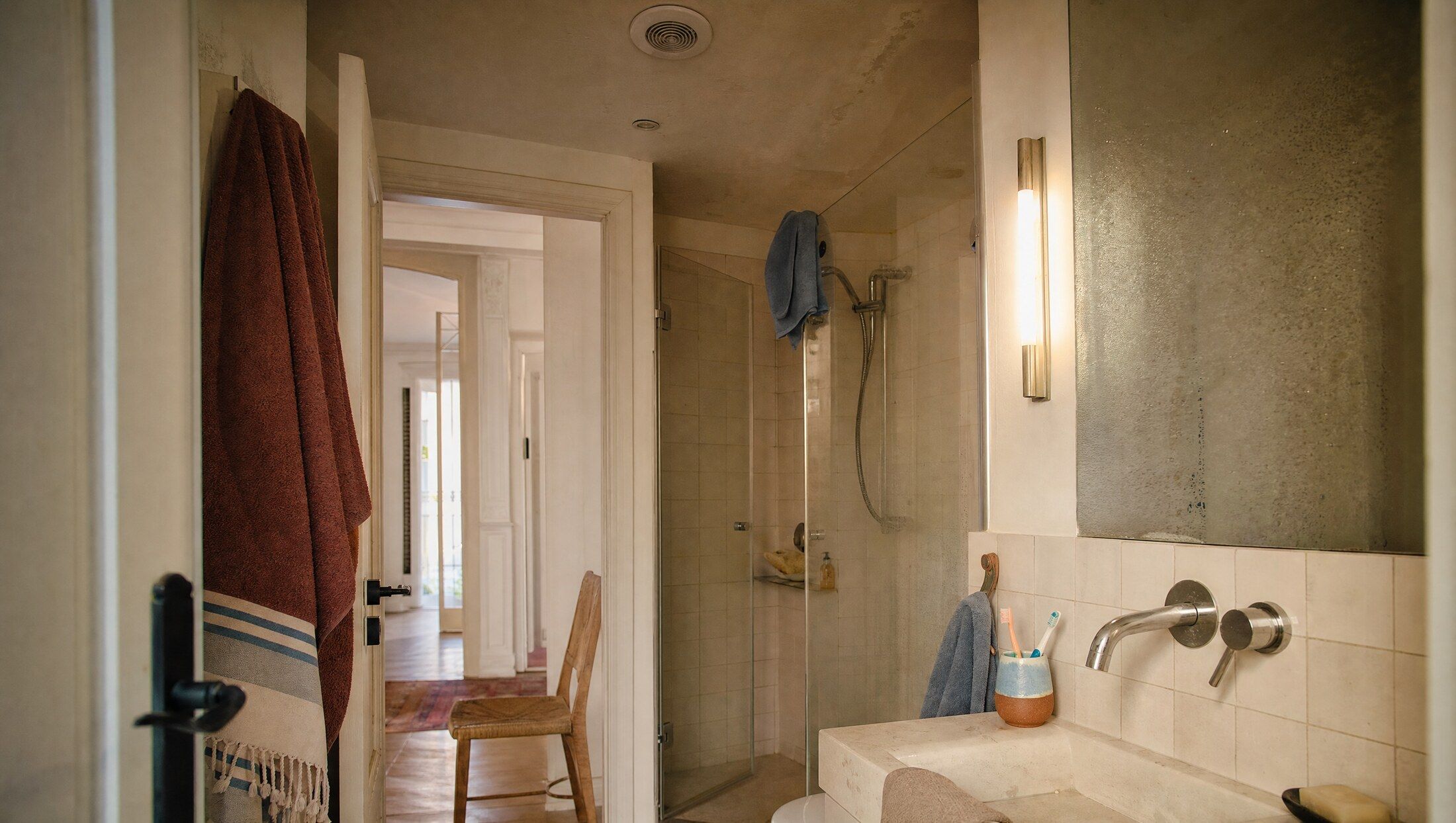
An easy-to-miss break in the route is at the bathroom door itself. A door with a real gap beneath it, or a grille in the leaf, admits replacement air as fast as the fan removes it. A door closing onto the floor, onto a new floor laid over the old one, or onto a draught excluder fitted to keep the noise down, gives the fan nothing to work with. A sealed bathroom door with no undercut and no transfer grille can therefore make an extractor appear to do nothing at all: the impeller turns exactly as it always did, and hardly any air moves.
There is a second level to this, and it catches out refurbished flats in particular. Even with a generous gap under the door, that air has to arrive from the rest of the dwelling, which needs its own way of taking in outdoor air. In a flat made much more airtight by new windows, with everything shut, the fan takes what it can find — often back down another wet room's duct, or through the cooker hood. New windows produce no moisture of their own. They remove the uncontrolled leakage the flat had been quietly relying on, which leaves the planned route carrying the whole load for the first time.
Where the steam collects, and where the extract sits
Two points decide how much of the room the air actually crosses: where it comes in, and where it leaves. Put them close together and the air takes the short way round while most of the room stands still.
Warm vapour rises. It builds a layer at ceiling height and along the upper walls, thickest above the shower. An extract point high on the wall or in the ceiling, and away from the door, works where the concentration is greatest. One low down works where there is almost none.
Then there is the short circuit. If replacement air enters under the door and the extract sits directly above that same door, the air travels half a metre and leaves, and the far end of the room — usually where the shower is — is barely swept at all. With the inlet and the outlet at opposite ends, the same air has to cross the zone that needs clearing.
Where an extract may go, and everything electrical attached to it, is not a domestic decision. Bathrooms are divided into zones by proximity to water, and the wiring is work for a qualified electrician.
The window plays a part worth understanding. Opening it while the fan runs clears the room quickly, and it also cancels the flow under the door: the fan will take the easy air from the window and stop drawing on the rest of the flat. For the bathroom that is a fine outcome. For the dwelling's renewal it counts for nothing.
Finally, the cold surfaces tell you where marks will appear:
- the mirror, always first, and therefore the cheapest indicator in the room;
- the ceiling angle above the shower, where the vapour piles up and the air reaches worst;
- the wall giving onto an interior light well — the pati de llum or patio de luces — with humid, barely moving outdoor air on the other side;
- the reveal around a small window, and the frame itself if it is aluminium without a thermal break.
One case is genuinely revealing. A bathroom in the middle of the plan, with no external wall, may have no surface cold enough to mark and may never stain. The vapour has not gone anywhere. It leaves through the door and condenses on the coldest surface it can find in another room.
Smells that are not from your flat
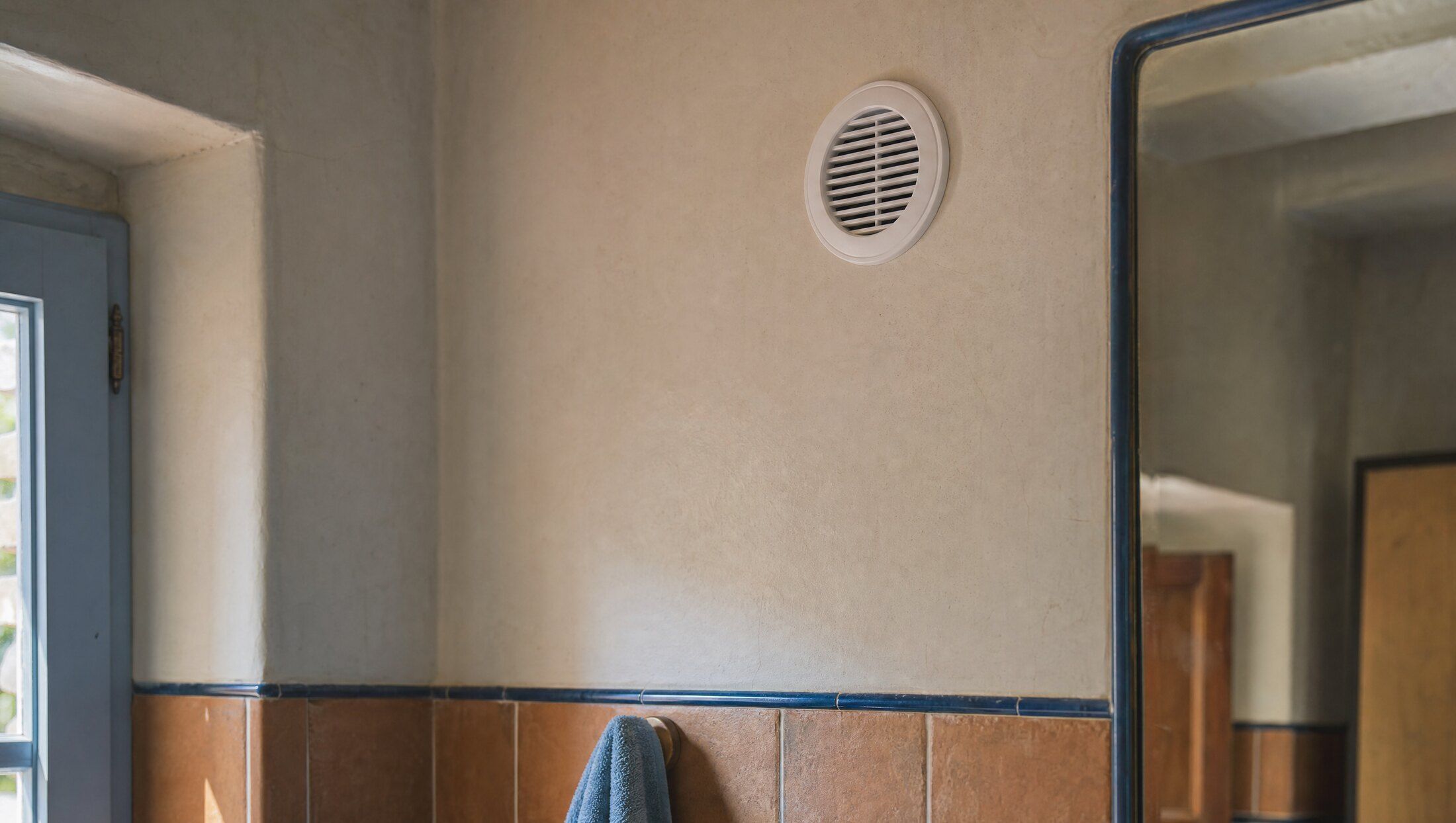
In blocks with stacked bathrooms, the extract often does not end at your wall. It ends in a shared vertical duct — a shunt, the word you will hear from tradespeople and at community meetings — which collects one branch per flat up a vertical line and discharges above the roof, driven by the temperature difference between the duct and the outside air.
The pressure inside that duct is not fixed. Wind across the roof, the temperature difference on a given day and whatever the neighbours happen to be doing all change it. Your fan is not pushing against a constant resistance; it is pushing against one that moves through the day.
This is where returning odours come from. If the branch has no backdraught shutter, or the shutter no longer seals, or the duct is pressurised by a gust or by a strong extract elsewhere on the line, air can travel the wrong way and come in. The signature is unmistakable: cooking, tobacco, another bathroom — smells that are not from your flat, and often stronger with your own fan switched off than with it running.
There is a quieter version too. Flat-by-flat refurbishment can leave a branch badly reconnected, an inspection hatch plastered over, or the duct partly obstructed with debris. The fan then discharges into something that does not evacuate, and swapping the appliance changes nothing at all.
Three things are not yours to do, whatever a video suggests:
- opening, drilling, extending or re-routing a communal duct;
- touching another dwelling's branch, or any shutter that is not on your own;
- discharging the extract into a false ceiling, a void, or an enclosed light well with no outlet.
The first two affect the whole vertical line and the safety of the building. The third simply returns the vapour to the room you have just taken it out of.
What is yours is the evidence. Record when the smell appears, whether it tracks windy days, whether it changes with your own fan on or off, and whether anyone else on the same line reports it. Take that to the comunidad de propietarios — comunitat de propietaris — because a shared duct is dealt with at building level, by people qualified to work inside it.
Whose problem is it: the room's or the flat's?
This is the question that saves the most money, because it separates a job in one room from a review of the whole dwelling.
| What you observe | What it points to | Where the work is |
|---|---|---|
| Only the bathroom fogs, and the mirror clears in a sensible time | A room-level issue | Air path, timing, and water left on surfaces |
| Glass streams in bedrooms or the living room on winter mornings too | The dwelling's moisture load against its renewal | The whole flat's air path |
| The bathroom stays clean, but the hallway wall, the back of a wardrobe or the next room's ceiling angle marks | Vapour leaving the bathroom and condensing elsewhere | Extraction at the point the vapour is made |
| Laundry is dried indoors, in the bathroom or a closed room | The main moisture source is not the shower | The source |
| It all began after the windows were replaced | Accidental infiltration removed, planned route exposed | The planned route |
Some signals point away from condensation altogether: marks that never dry out, including in dry weeks and through the summer; damp along the bottom of a wall, rising from the floor; a stain directly beneath the bathroom of the flat above, or around a soil pipe; staining that grows only after rain or onshore wind. Leaks, rising damp and rain penetration are different mechanisms with different remedies, and they cannot be told apart reliably without an on-site inspection. Pushing harder on ventilation while a pipe is leaking only extends the damage.
Where persistent damp has already produced visible mould, it is not worth living alongside. World Health Organization guidance on dampness and mould supports linking persistent indoor dampness and mould with respiratory symptoms. Removing mould that is already there and correcting the air are two different jobs, and correcting the air does not guarantee that it will not come back.
Fixes that feel right and change nothing
A dehumidifier parked in the bathroom. It takes moisture out of the air already in the room and renews nothing. Against surfaces evaporating all morning behind a closed door, it is working on the wrong side of the problem.
A more powerful fan bought before checking the inlet. If nothing arrives under the door, extra suction against a closed room buys extra noise. Which fan, and how much air it should move, is a question worth asking — but only once you know the air has a way in.
The window left permanently on the tilt latch. It chills the reveals and the surfaces continuously, which is the opposite of what you want where condensation forms, and it tends to get shut during a cold week anyway. Wide open for a short spell, during and just after the shower, moves far more air.
Taping over the grille in winter to stop the draught. That removes the renewal without touching the moisture being produced. It is the most understandable reaction to a cold bathroom, and it makes the following two winters worse.
Painting over the stain. Paint on a marked ceiling acts on none of the three things that put the water there — how much moisture is produced, how much air removes it, how cold the surface is. It hides the signal until it comes back.
Keeping the door shut to contain the damp. This one is exactly backwards. With the fan off and the door closed, the room becomes a sealed box with wet surfaces inside it, and the drying has to happen anyway, more slowly, into whatever air is trapped in there.
Work through it in this order
- Take away the water that has not evaporated yet. A squeegee across the screen and the tiles takes half a minute and removes the bulk of what would otherwise become vapour over the morning. Wet towels out of the room. No laundry drying in there.
- Open the path. Check the gap under the door with the fan running, and make sure somewhere else in the flat can take in outdoor air at the same time.
- Extend the removal past the shower. Extraction that stops with the light only ever served the short clock.
- Leave the room open when it is not in use, so it is not standing as a closed box with wet surfaces in it.
- Only then look at the appliance and the duct. If the mirror still takes an age to clear with the door open and the surfaces dried, the fault is in the hardware or in what it discharges into.
The first four steps cost nothing, and they are also the diagnosis. If you reach the fifth having done them, you are no longer describing a damp bathroom to somebody. You are describing which link is broken, which is a far more useful thing to arrive with.
Tell us what's happening at home and, if useful, add photos. A message does not replace an on-site professional assessment.
Tell us about your situationSources
The technical and regulatory statements on this page rest on the sources below.
- Documento Básico HS «Salubridad», Código Técnico de la Edificación — Ministerio de Vivienda y Agenda Urbana / Código Técnico de la Edificación
- Guia d’aplicació del DB HS 3 — Qualitat de l’aire interior — Col·legi d’Arquitectes de Catalunya
- Ventilació mecànica controlada en habitatges — Generalitat de Catalunya — Departament d’Habitatge
- WHO Guidelines for Indoor Air Quality: Dampness and Mould — World Health Organization