Bathroom
How to choose a bathroom extractor fan in a Spanish flat
Decide in this order: the volume of the room, the flow it needs, the duct that is already behind the wall, the flow the fan will really deliver against that duct, the noise, and the control. The figure printed on the box is measured with nothing attached to the fan, which makes it the one number that tells you least about your own bathroom.
On this page

- Outdoor air and cold surfaces
- Indoor air, warm and moist
- Transfer between rooms
The six decisions, in the order that matters
The first three have nothing to do with any catalogue. They are about the room you have, the duct already sitting behind the wall, and how the household uses the bathroom. The last three are only readable against them, which is why by the time you reach a product page most of the candidates have eliminated themselves.
- Room volume. Width by depth by height, in cubic metres.
- The flow that volume needs. How much air has to leave this particular room.
- The duct. Its real length, its diameter, how many bends, and where it discharges.
- The flow you will actually get. What the fan delivers against that duct, not in open air.
- Noise. How loud it will be in a small tiled room, at the hours it will be running.
- Control. Manual, timer, humidistat or presence — what decides when it runs at all.
Steps three and four settle the purchase, and they are exactly the two that never appear on the packaging. Between two units, the one that holds its flow against resistance will move more air in your bathroom than the one advertising the bigger headline number.
From the size of the room to the flow you are looking for
Volume is tape-measure arithmetic: width by depth by height, in metres. If the bathroom has a suspended ceiling, measure to the visible ceiling, not to the slab above it. The air you have to renew is the air in the room.
From there, two routes lead to a target flow, and they do not carry the same weight.
The first is the technical reference. Spain regulates dwelling ventilation through the Código Técnico de la Edificación — the CTE, the national building code — in the section known as DB-HS3. It sorts a home into dry rooms, where outdoor air is admitted, and wet rooms, from which air is extracted, with transfer openings between them, and it tabulates minimum extraction flows for those wet rooms. The application guide published by the Catalan architects' association and the Generalitat's own material on mechanical ventilation in dwellings both work from that table. It is a figure to look up rather than to estimate, and it stays the best reference you have even when you are only swapping a unit in a finished flat.
The word on every quotation and datasheet is caudal: airflow rate. Spanish product data usually states it in cubic metres per hour, m³/h, while material written for the British market tends to use litres per second, l/s. They measure the same thing — multiply l/s by 3.6 to get m³/h — and mixing them up is an easy way to compare two fans that were never comparable. One habit worth leaving at the border: a fan sold into another country is described against that country's building requirements, and those requirements do not travel with the box.
The second route is the commercial shortcut: multiply the volume by a number of air changes per hour. It is what sits behind "suitable for bathrooms up to so many square metres" on the packaging, and it has two faults at once. Square metres ignore ceiling height, and the sum assumes an ideal duct that nobody has.
Use matters too. One shower a day for one person and four back to back on a weekday morning load the same room very differently, and a bathroom where laundry is hung to dry is a different case again. The table gives you the floor; how the room is used tells you whether to work above it.
The box quotes free air; your duct does not
The large number on the packaging is a free-discharge figure — caudal a descarga libre — measured with the fan's outlet open to the room and nothing attached. It is a laboratory condition that exists in no bathroom.
In a real installation, the air has to get past all of this before it reaches the street:
- the full length of the duct, followed along its actual path rather than measured in a straight line;
- every bend, each of which costs far more than its own length, especially a tight one;
- corrugated flexible ducting, which rubs at the airflow far more than smooth rigid pipe, and worse still where it sags or is pinched in a ceiling void;
- any reduction below the diameter of the fan's own spigot, probably the single most damaging decision available during the fit;
- the external grille and its insect mesh, which foul over time;
- and, where the run joins a shared duct, whatever pressure already exists inside it.
Added together, that is pressure loss — pérdida de carga — and the result never varies in direction: less air than the box promised.
What a useful datasheet shows
A specification worth reading does not give a number. It gives a curve of flow against static pressure, in pascals. That curve answers the only question that matters: how much air the unit still moves once it meets resistance. Where a manufacturer publishes a maximum flow and no curve, there is nothing to compare.
The shape of the curve separates families of fan. A simple axial unit — helicoidal in Spanish catalogues — sheds flow quickly as pressure rises, which is fine on a short, direct run to the façade. A centrifugal or mixed-flow unit holds its flow against pressure far better, which is what a long, bendy or shaft-connected run demands. In those installations, the gap between the two curves matters more than the gap between the two headline figures.
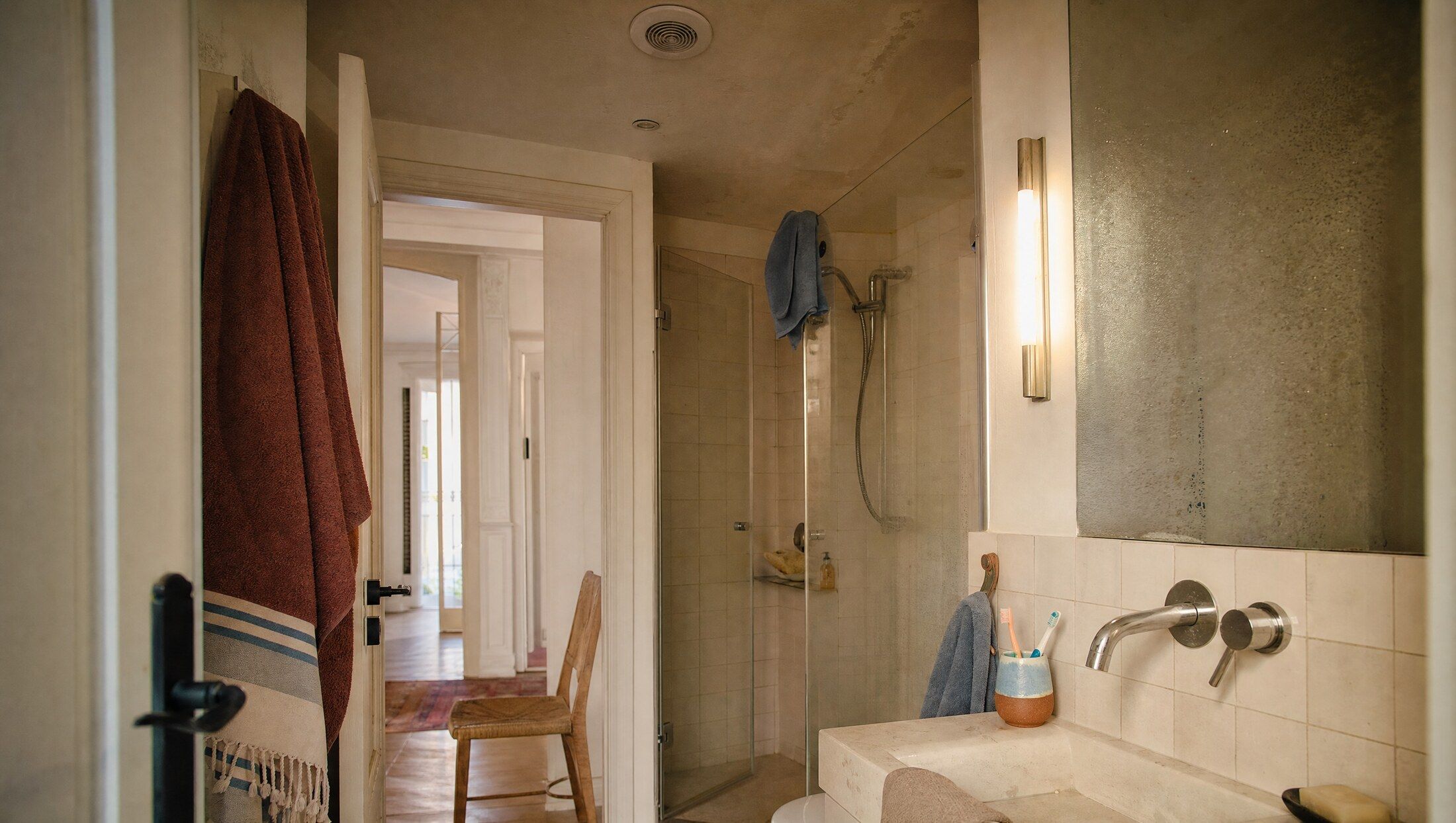
A short run to the façade is not the same purchase as a shunt connection
Where the duct goes changes the rules enough that it belongs before any product research.
A short, direct run to the outside. The favourable case: a couple of metres, no unnecessary bends, rigid pipe, a clean external grille. A modest unit does the job. One local qualification: where the outlet gives onto a narrow interior light well — the patio de luces, pati de llum — the air in that shaft is humid and slow-moving, so you are discharging into a space that renews itself with difficulty. Better than not extracting, but it will not perform like an opening onto the street façade.
A connection into a shunt, the building's shared vertical duct. A shunt is not a neutral hole. It has its own pressure, other dwellings feed into it, and what happens inside it is not under your control. Two things follow. The fan has to work against pressure, which points back at the curve rather than the maximum flow; and the connection wants a backdraught shutter — an antirretorno — because with the fan idle a shared duct can hand you back air and smells from elsewhere. Opening, diverting or altering that duct is outside what you decide alone: it is a communal element of the building, and any work on it runs through the community of owners and through people qualified to carry it out.
Ducts that arrive nowhere. A pipe finishing inside a suspended ceiling or a closed void extracts nothing. It relocates the moisture to somewhere nobody will look until it does damage. And a filtering unit that recirculates into the room is not extraction at all, however it is marketed: the vapour that was supposed to leave stays in the flat.
A fan can only remove the air that something lets in
A fan does not manufacture air, it displaces it. For every cubic metre leaving the bathroom, a cubic metre has to enter from somewhere. DB-HS3 describes precisely that route — from the dry rooms, across the dwelling, into the wet rooms and out — with internal transfer openings, aberturas de paso, doing the crossing.
The door is an easy place for the route to break. A bathroom door fitted tight to the floor, with no undercut and no transfer grille, is an easy-to-miss reason an extractor fan can appear to be doing nothing. It can happen quietly during refurbishment: the new door closes better than the old one, a new floor covering takes up the remaining gap, and the air path disappears without anyone deciding to remove it.
Two things to check before you buy anything, not after:
- Look at the gap. With the door shut and the floor as it will finally be, is there a visible undercut, or a grille or louvre in the leaf?
- Listen at the door. Run the existing fan with the door shut, then prop it open a hand's width. If the fan's note changes as the door swings, it had been straining against a closed room, and a more powerful unit would only strain harder.
The same logic scales up to the whole flat. Where windows have been replaced with much more airtight units and nothing was put back in their place, no room has a designed way for outdoor air to enter. The bathroom is then not the problem, only where the problem shows first.
Noise is a buying criterion, not a footnote
A loud fan gets switched off, and a fan that is off ventilates nothing, whatever its datasheet says. Noise belongs beside flow in the decision, not at the end of it as a tiebreaker.
The dB(A) figure on a specification is measured at a stated distance under laboratory conditions — check which distance, because datasheets differ. A real bathroom is small, enclosed and finished in hard surfaces: tile, mirror, glass, porcelain. Nothing absorbs and everything reflects, so the same unit sounds louder in the room than it does on paper.
The sound also has several origins, and each is a different problem:
- the motor, which is what the datasheet measures;
- air friction, which rises with a narrow duct or any reduction in diameter;
- vibration carried into the wall or the ceiling void, often what the neighbours and the adjoining bedroom hear most;
- a badly seated grille, rattling for reasons that have nothing to do with the fan.
At equal flow, a larger unit turning slowly is quieter than a small one turning fast. There is also a way to move the noise away entirely: an in-line fan mounted along the duct run outside the room, leaving only the grille in the bathroom. It transforms perceived noise, but it needs space and it is an installation decision rather than a purchase you settle by yourself.
Think about the hours, too. If the fan runs on after the light goes off and the bathroom shares a wall with a bedroom, the noise you do not mind at eight in the morning is what makes somebody disconnect the timer within a fortnight.
Manual, timer, humidistat or presence detector
The control does not change how much air the fan moves. It changes when it moves it — and since the moisture from a shower leaves the room after the shower rather than during it, this is often the difference between a useful fan and an ornamental one.
| Control | How it decides | Where it fails |
|---|---|---|
| Its own switch | You turn it on and off | Left running all day, or never switched on |
| Wired to the light | Runs while the light is on | Stops exactly when the water starts evaporating |
| Timer overrun | Keeps going for a set time after the light goes off | Fixed period: a long shower and a quick visit get the same |
| Humidistat | Starts and stops on relative humidity | Badly set threshold: either never starts or never stops |
| Presence detector | Starts on movement | It detects people, not vapour |
The humidity sensor is the only one watching the quantity you are actually trying to remove, which makes it the sensible default in a heavily used bathroom. But on a Mediterranean coast, with hot humid summers and mild humid winters, the background humidity is already high for months at a time. A fixed-threshold humidistat can sit switched on for days in August and never trigger in January. What works here is an adjustable threshold, or a unit that responds to a rapid rise in humidity rather than an absolute value, with a manual override you can reach.
Presence detection alone fits the room least well: someone can come and go producing no vapour at all, while a full bath produces plenty with nobody in it.
When no extractor fan is the answer
Some situations are not solved by a purchase, and recognising them early saves both money and a wasted fitting:
- The damp appears in other rooms too. Streaming glass in the bedroom or the living room points at renewal across the whole dwelling, not at extraction from one room.
- The mark is always in the same cold corner. An external wall angle, a thermal bridge, the wall behind a wardrobe: there the dominant variable is surface temperature, and pulling more air out of the bathroom does not warm it.
- The patch never dries, not even through dry spells, or grows after rain, or climbs from the floor. Leaks, rising damp and rain penetration are different mechanisms with different remedies, and they are not told apart reliably without an on-site inspection.
- There is no route for replacement air anywhere in the flat. Until air can get in, adding extraction capacity is pushing against a closed box.
- The shared duct does not draw. A blocked or badly terminated shunt is not bought in a shop. It is a matter for the building.
There is a quick way to place your own case. For a few days, run the extract properly — fan on well past the end of the shower, door propped open so air can reach the room — and change nothing else. If surfaces dry visibly sooner, extraction was the constraint and everything above applies to you. If the room behaves the same open as shut, look at the duct before you look at motors. And if a fortnight of either changes nothing, the water is not arriving through this room's air, and no fan on any shelf will take it away.
Tell us what's happening at home and, if useful, add photos. A message does not replace an on-site professional assessment.
Tell us about your situationSources
The technical and regulatory statements on this page rest on the sources below.
- Documento Básico HS «Salubridad», Código Técnico de la Edificación — Ministerio de Vivienda y Agenda Urbana / Código Técnico de la Edificación
- Guia d’aplicació del DB HS 3 — Qualitat de l’aire interior — Col·legi d’Arquitectes de Catalunya
- Ventilació mecànica controlada en habitatges — Generalitat de Catalunya — Departament d’Habitatge